

Ask most people in the Gulf what oud is and they will describe a smell. Warm, deep, resinous, slightly smoky, unmistakably part of home.
That description is accurate but it covers at least three genuinely different products that behave differently, cost differently, and belong in different parts of a home. Oud wood. Bakhoor. Oud diffuser oil.
The confusion matters because people buy one expecting the properties of another and end up disappointed by something that was never designed to do what they wanted from it.
What oud actually is before anything is done to it
Oud is the resinous heartwood of the Aquilaria tree. Healthy Aquilaria wood is pale, light, and almost odourless. It becomes oud only when the tree is infected by a specific mould, at which point it produces a dark aromatic resin as a defensive response.
This is why oud is expensive. It is not harvested, it is waited for. Only a small percentage of wild Aquilaria trees develop the infection, the resin accumulates over years or decades, and the concentration of aromatic compounds increases with age.
Everything else in this article is a different way of releasing what is already in that resin.
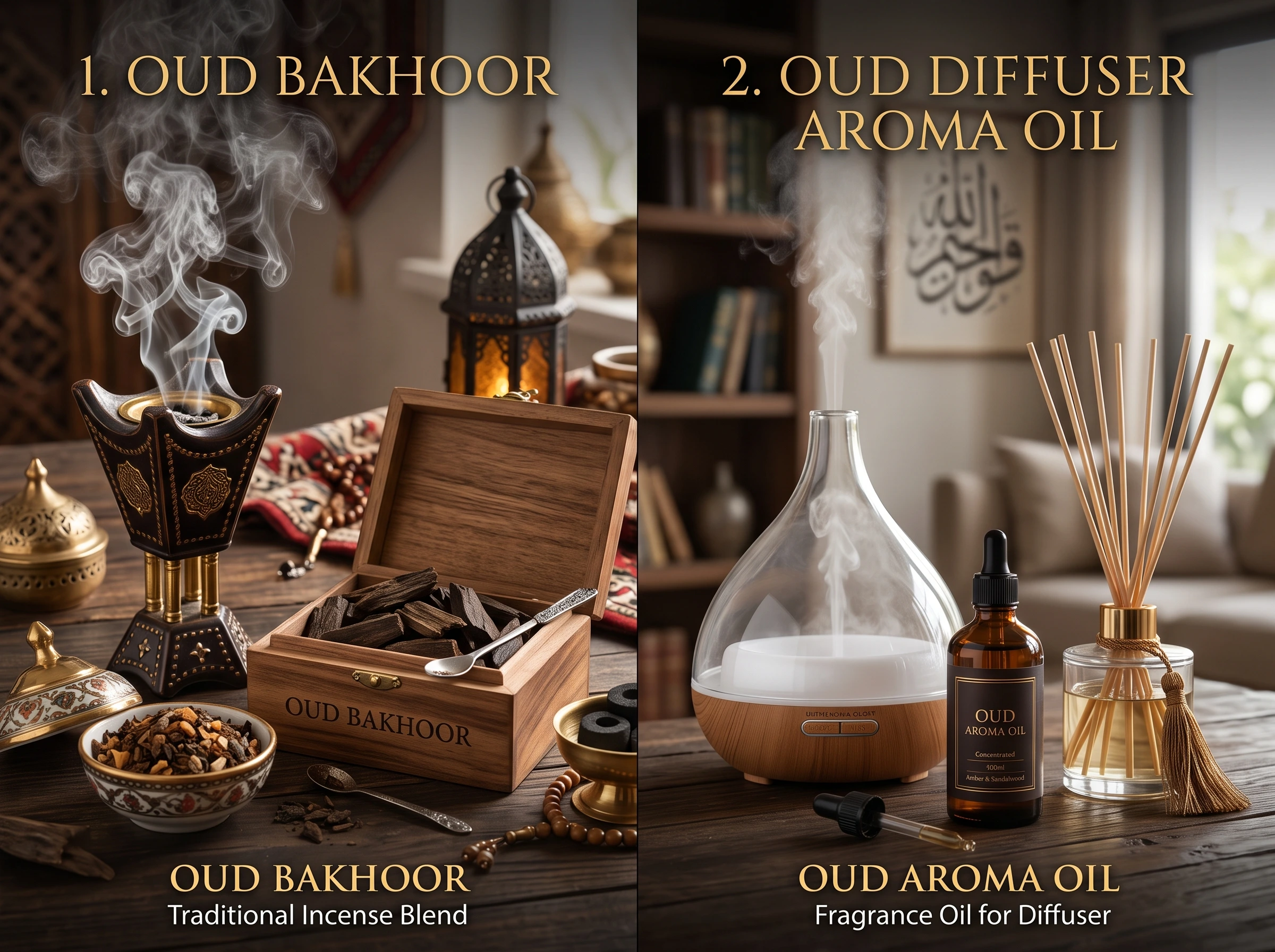
Bakhoor: oud released by heat
Bakhoor is oud wood chips, often blended with other aromatic materials and sometimes soaked in fragrance oils, burned over charcoal or on an electric burner.
The mechanism is combustion. Heat drives the aromatic compounds off the wood rapidly and carries them into the room on smoke.
What that produces is intensity. Bakhoor fills a space quickly and powerfully, and the smoke itself becomes part of the experience. It clings to fabric, to hair, to majlis cushions. It lingers for hours after the burner has cooled.
That persistence is the point culturally. Bakhoor is not ambient scenting. It is an event. It marks arrivals, gatherings, Friday afternoons, occasions. The strength is a feature, not a limitation.
But heat has a cost that is worth understanding. Combustion changes the molecular structure of what it burns. The lightest and most volatile aromatic compounds in the resin, the ones responsible for the opening character of the fragrance, are the first to be altered. What survives the flame is the heavier base of the profile.
This is why bakhoor smells like oud but does not smell like the full complexity of the resin it came from. You are experiencing what remains after burning, not what was there before.
Oud diffuser oil: the same material, released without heat
Oud diffuser oil is a professionally formulated fragrance oil built around oud extract and oud isolates, designed to be atomised at room temperature.
The mechanism is pressure rather than combustion. A cold air system uses pressurised air to break the oil into particles measured in microns. No flame, no smoke, no thermal change to the compounds.
What that produces is a different experience from bakhoor entirely.
The full profile arrives intact. The top notes that combustion destroys reach the room unchanged, which means the fragrance opens with brightness before settling into the warm resinous heart most people associate with oud. It develops over a session rather than arriving all at once.
It is also ambient rather than event based. Bakhoor is deliberately noticeable. Diffuser oil is designed to fill a room at a level that registers without demanding attention, and to do that consistently for hours rather than in a single intense burst.
Neither is better. They are answers to different questions. Bakhoor answers how do I mark this occasion. A diffuser aroma oil built around oud answers how do I make this room consistently smell like a place I want to be.
Why pure oud oil is not the same as oud diffuser oil
This is where a lot of expensive mistakes get made.
Pure oud oil, dehn al oud, is the distilled essential oil of the resin. It is one of the most expensive fragrance materials in existence and it is extraordinary as a personal fragrance applied to skin.
It is also thick. Viscous, dark, closer to a syrup than to a free flowing oil.
That viscosity is a problem for atomisation. Cold air diffusers are engineered for a specific range of oil thickness. Below that range the oil evaporates before proper particle formation. Above it, the oil will not draw cleanly into the airstream, particle sizes become inconsistent, and residue builds on the mechanism over time.
Pure dehn al oud sits well above the workable range. Putting it directly into a scent diffuser produces weak, uneven output and gradually degrades the device.
Professional oud diffuser oils solve this by formulating around the oud character rather than using raw resin extract at full concentration. Oud isolates and complementary aromatic compounds are combined at a viscosity the atomiser can handle, while preserving the profile that makes oud recognisable.
That is a formulation discipline, not a dilution. The result is not weaker oud. It is oud restructured so the delivery method can actually deliver it.
Where each one belongs in a UAE home
Bakhoor belongs to occasions and to the majlis. Guests arriving, Friday gatherings, Ramadan evenings, moments where the scent is meant to be noticed and remembered as part of the event.
Oud diffuser oil belongs to the ambient life of the home. The entrance that greets you every day. The living area through the evening. The consistent character of a space rather than the marking of a moment.
Pure oud oil belongs on skin, or in a collection, or as an occasional drop on fabric. Not in a diffuser.
Most UAE homes that get this right use two of the three. Bakhoor for occasions, kept for when it matters. Oud diffuser oil running quietly underneath everything else, giving the home a consistent identity that visitors notice without being able to name.
The mistake is expecting either one to do the other’s job.
Frequently Asked Questions
What is the difference between bakhoor and oud diffuser oil?
Bakhoor is oud wood burned over charcoal or an electric burner, releasing fragrance through combustion. Oud diffuser oil is a formulated fragrance oil atomised at room temperature by pressurised air. Combustion alters the lighter aromatic compounds in the resin, so bakhoor delivers the heavier base of the profile with smoke as part of the experience. Cold air diffusion preserves the complete compound profile, producing a fuller and more consistent ambient scent without smoke or residue.
Can you put pure oud oil in a diffuser?
Not directly. Pure dehn al oud is highly viscous, well above the thickness range cold air atomisers are engineered to handle. It draws unevenly into the airstream, produces inconsistent particle sizes, and leaves residue that degrades the mechanism over time. Oud diffuser oils are formulated using oud isolates and complementary compounds at a workable viscosity, which preserves the oud character while allowing proper atomisation.
Does oud diffuser oil smell the same as bakhoor?
Related but noticeably different. Both carry the recognisable warm resinous oud character. Bakhoor adds smokiness from combustion and delivers a more intense, shorter lived experience that clings to fabric and hair. Oud diffuser oil opens with the lighter top notes that burning destroys, then settles into the resinous heart, producing a fuller development and a more even ambient presence over several hours.
Why is oud expensive?
Oud forms only when an Aquilaria tree becomes infected by a specific mould and produces resin in response. Only a small proportion of wild trees develop this infection, the resin accumulates over years or decades, and aromatic concentration increases with age. The material cannot be reliably farmed on demand at wild grade quality, which is what drives the price of genuine oud in all its forms.
Should a UAE home use bakhoor or oud diffuser oil?
Most homes that get this right use both for different purposes. Bakhoor suits occasions, guest arrivals, Friday gatherings and Ramadan evenings, where the scent is meant to be noticed as part of the event. Oud diffuser oil suits the everyday ambient character of the home, particularly entrances and living areas, running consistently at a level that registers without demanding attention.