

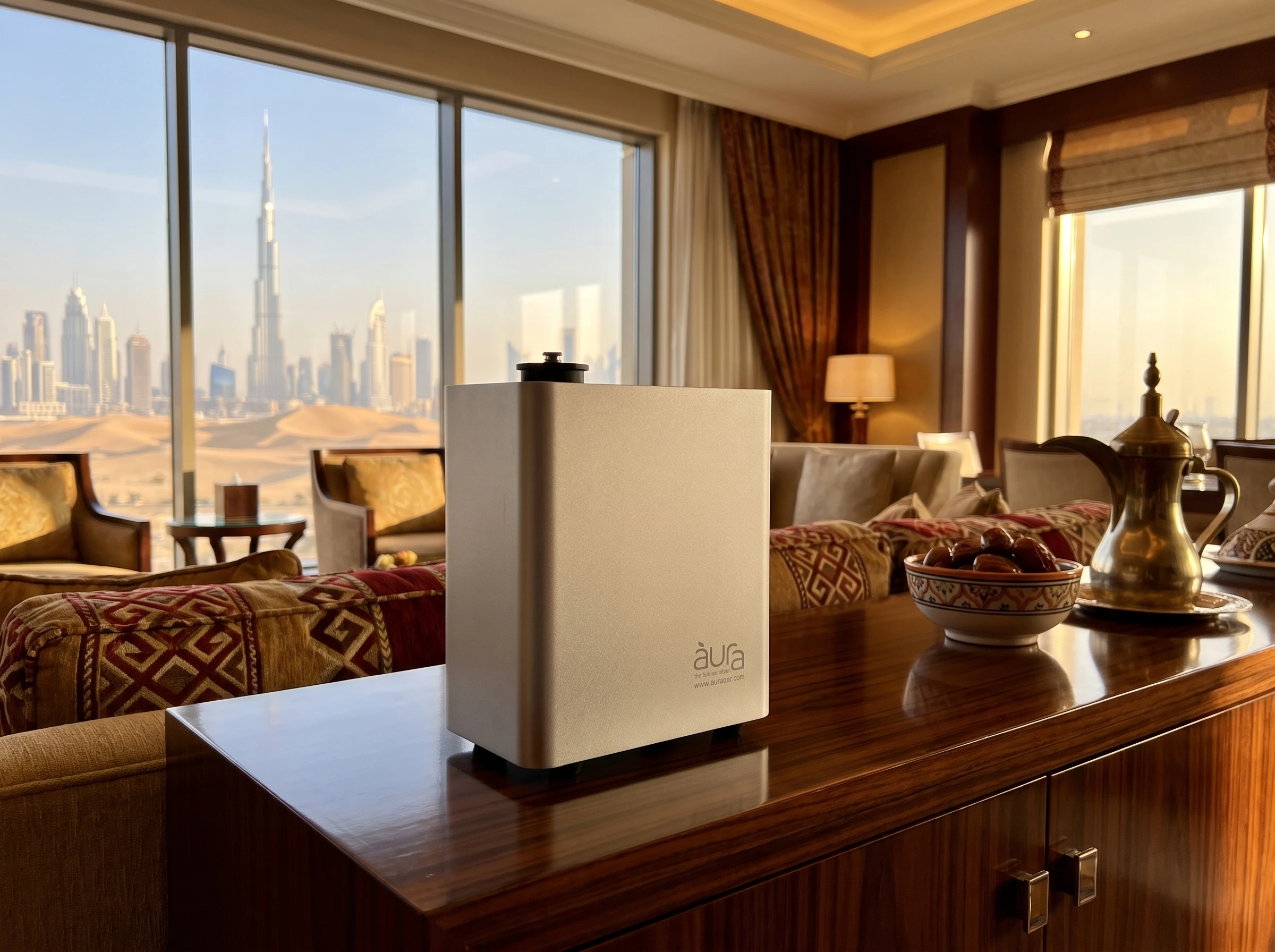
There is a specific conversation that happens after someone buys a diffuser and finds it underwhelming.
They describe the room. Forty square metres, they say. The device was rated for sixty. It should be more than enough.
The device was never rated for sixty square metres. It was rated for sixty cubic metres, and the room they are describing contains a hundred and forty.
This single conversion error accounts for more disappointing purchases than any other factor in home fragrance, and almost nobody catches it before buying.
The calculation
Coverage ratings on diffusers are given in cubic metres because fragrance fills a volume of air, not a surface.
The number you need is floor area multiplied by ceiling height.
A room measuring eight metres by five metres has a floor area of forty square metres. With a ceiling at three and a half metres, that room contains a hundred and forty cubic metres of air.
The difference between forty and a hundred and forty is the entire problem. Someone reading the floor plan number and comparing it against a coverage rating is comparing two figures that measure different things.
Why this hits UAE homes harder
Ceiling height is the variable, and UAE construction sits well above the norm most coverage figures are tested against.
A standard European apartment ceiling runs around two point four metres. Standard UAE apartment ceilings run three to three and a half. Villa reception areas commonly reach four metres, and double height entrance halls in larger properties go to five or six.
Take the same forty square metre floor plan across those conditions.
At two point four metres, ninety six cubic metres. At three point five metres, a hundred and forty. At four metres, a hundred and sixty.
That is a sixty percent swing in air volume for an identical floor plan. A device correctly specified for a room in Manchester is meaningfully undersized for the same room in Dubai, and nothing on the packaging indicates that, because the packaging was written for the market where the testing happened.
Open plan makes it worse
The second UAE specific factor is layout.
Contemporary UAE apartments and villas favour connected living, dining and kitchen spaces without dividing walls. On a floor plan these read as separate zones. To air, they are one continuous volume.
Fragrance does not respect a change in flooring or a kitchen island. It fills whatever space is connected to it.
So a living area of forty square metres connected to a dining space of twenty five and an open kitchen of twenty is not a forty square metre problem. It is eighty five square metres of floor, and at three point five metres of ceiling, roughly three hundred cubic metres of air.
Most consumer devices are rated somewhere between a hundred and two hundred cubic metres. Placing one in that space produces a well scented sofa area and a dining table that smells of nothing.
The air conditioning adjustment
There is a third factor that no coverage rating accounts for, because it does not exist in the testing environment.
Coverage figures are established in still air. UAE homes run air conditioning continuously for most of the year, which means the air is never still. It moves in a steady directional pattern from supply vents toward return vents, and some proportion of any airborne particle is drawn out of the room and through the system.
This is not entirely a loss. Cold air diffusion produces dry particles light enough to travel with that airflow, which distributes fragrance to corners still air would never reach. The ventilation becomes a delivery mechanism.
But there is still turnover. Air leaving the room takes fragrance with it, and the higher the air exchange rate, the more continuous the replacement needs to be.
The practical adjustment is to add roughly twenty percent to your calculated volume when choosing a device for a UAE room with air conditioning running through the operating hours. A room of a hundred and forty cubic metres is better served by a device rated for a hundred and seventy or above.
Working through a real example
Take a typical Dubai apartment.
Living and dining connected, sixty square metres of combined floor, three point five metre ceiling. That is two hundred and ten cubic metres. Add twenty percent for air conditioning turnover and the working figure is around two hundred and fifty.
A device rated at a hundred and fifty will scent part of that space adequately and leave the rest thin. A device rated at two hundred and fifty or above covers it properly.
The bedroom in the same apartment might be sixteen square metres with the same ceiling. Fifty six cubic metres, seventy with the adjustment. A compact unit handles that comfortably, and a large one would be overpowering at any setting.
The entrance hall might be eight square metres but with a double height ceiling at six metres. Forty eight cubic metres, which sounds small but the volume is vertical, and particles disperse upward. A mid range unit positioned at around a metre off the floor works better here than a compact one placed high.
Three rooms, three different answers, all from the same calculation applied to actual dimensions.
What to do before buying
Measure the rooms. Length by width by ceiling height. Include any connected space that has no door between it and the room you are scenting.
Add twenty percent if the air conditioning runs while the device will be operating, which in a UAE home is most of the time.
Compare that figure against the coverage rating on the scent diffuser you are considering, and choose one rated at or above it rather than at the minimum.
The oil matters too, though for a different reason. Consistent particle formation depends on the diffuser oil sitting within the viscosity range the atomiser was built for. A correctly sized device running an unsuitable oil still underperforms, because the mechanism cannot produce the particle size the coverage rating assumes.
Get both right and the coverage figure on the box becomes an accurate prediction rather than an optimistic one.
Frequently Asked Questions
How do I calculate what size diffuser I need?
Multiply the room’s floor area by its ceiling height to get cubic metres, which is the unit coverage ratings use. A room of forty square metres with a three and a half metre ceiling contains a hundred and forty cubic metres. Include any connected spaces without a dividing door, since air treats them as one volume. Then add roughly twenty percent if air conditioning will be running, and choose a device rated at or above that final figure.
Why do UAE rooms need larger diffusers than the same size room elsewhere?
Ceiling height. UAE apartment ceilings typically run three to three and a half metres against a European standard of around two point four, and villa reception areas often reach four metres or more. The same floor plan can hold sixty percent more air in a UAE property. Since coverage ratings are usually tested in markets with lower ceilings, a device correctly specified elsewhere is frequently undersized here.
Does an open plan layout change diffuser sizing?
Significantly. Air moves freely between connected spaces regardless of flooring changes or kitchen islands, so a living area open to a dining space and kitchen is one continuous volume rather than three separate rooms. Calculate the combined floor area of all connected spaces and multiply by ceiling height. This is why a device that would comfortably handle an enclosed room of the same nominal size falls short in an open plan UAE apartment.
Does air conditioning affect how large a diffuser needs to be?
Yes. Coverage ratings are established in still air, but UAE homes run air conditioning continuously, moving air steadily from supply vents toward return vents. Some proportion of airborne fragrance is drawn out of the room through that system. Adding around twenty percent to your calculated cubic metre figure compensates for the higher air exchange rate and gives more reliable coverage during operating hours
What happens if the diffuser is undersized for the room?
The area immediately around the device scents normally while the rest of the room stays thin or neutral. Raising the intensity does not resolve it, because the limitation is the volume of air the mechanism can saturate rather than the concentration it produces locally. Increasing output only accelerates oil consumption. The fix is either a correctly rated device or a second unit positioned in the underserved zone.