

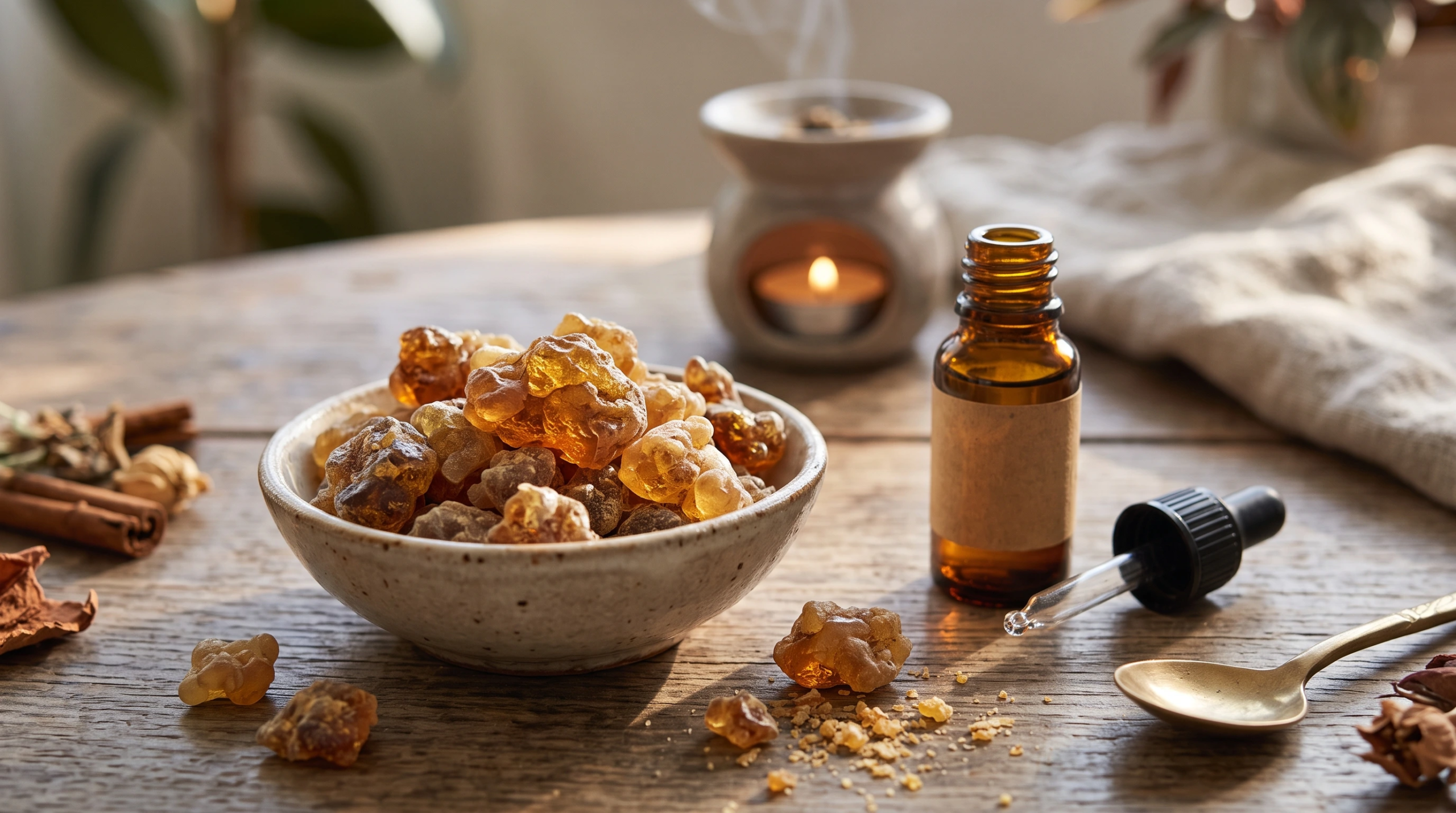
Amber appears on the note list of an enormous number of fragrances and almost nobody who buys them could say what it is.
Unlike rose or sandalwood, there is no amber plant. There is no amber tree and no amber extract. The material does not exist in the way most fragrance ingredients exist, and yet it is one of the defining characters of Gulf perfumery.
Understanding what amber and the resin family actually are explains why they behave the way they do in a sealed room, and why they suit UAE interiors better than almost anything else.
Amber is a construction, not an ingredient
Amber in perfumery is an accord. A combination of materials assembled to produce a particular effect, rather than a single thing extracted from a plant.
The classical construction pairs labdanum, a sticky resin from the rockrose shrub, with vanilla and benzoin. Labdanum brings a warm, slightly leathery, faintly animalic depth. Vanilla rounds and sweetens it. Benzoin adds a balsamic softness that holds the whole thing together.
Different houses build amber differently. Some lean heavily on labdanum for a darker, more resinous result. Others push the vanilla for something sweeter and rounder. Gulf amber constructions tend toward the former, deeper and less sweet than the Western interpretation.
This is why two fragrances both listing amber can smell substantially different. You are not comparing the same ingredient. You are comparing two recipes that happen to share a name.
What resins physically are
Resins are a tree’s defensive response to injury. Bark is damaged, sap flows to seal the wound, and over time it hardens into an aromatic solid.
Frankincense comes from Boswellia. Myrrh from Commiphora. Benzoin from Styrax. Labdanum is gathered from the leaves and twigs of rockrose. Each one is a plant protecting itself, and the aromatic complexity is a by product of that biological process.
That origin explains the shared characteristics. Resins are dense, slow to release, and built from heavy molecules. They were never meant to evaporate quickly, because the biological purpose was to seal and remain.
In fragrance terms this produces materials that establish slowly, persist for very long periods, and resist being dispersed or cleared.
Why that behaviour suits a sealed UAE room
The connection between the material properties and the local environment is direct.
A sealed interior with continuous air conditioning has a high air exchange rate. Air enters, circulates, and returns to the system repeatedly through the day. Anything airborne is subject to that turnover.
Light volatile molecules do badly here. They disperse quickly and are then removed through the return vents. A fragrance built primarily on bright material can feel thin in a UAE room, not because it lacks quality, but because the environment clears it faster than it can establish.
Heavy resin molecules are considerably more resistant. They disperse more slowly and persist longer once present, so a greater proportion of what is released remains in the room across the operating period.
There is a further effect worth knowing. Resin molecules deposit onto soft surfaces, curtains, upholstery, majlis cushions, and re release gradually over following hours. That creates a reservoir effect where the room retains character between diffuser cycles rather than returning to neutral each time the device pauses.
Light fragrances do not do this. Resins do it reliably, which is why a room scented with an amber or frankincense composition still carries the character the following morning.
The individual materials and what each contributes
Labdanum is the backbone of most amber constructions. Warm, slightly leathery, with a depth that reads as expensive rather than sweet. It carries the longest of the amber components.
Benzoin is softer and more balsamic, with a subtle vanilla quality of its own. It smooths sharp edges in a composition and acts as a fixative, slowing the release of lighter materials around it.
Frankincense is the brightest of the resin family, with a clean, slightly citrus and peppery quality above the resinous base. It lifts a heavy composition without lightening it, and it is the resin most culturally embedded in Gulf domestic practice.
Myrrh is darker and more bitter, medicinal in the way old apothecaries were medicinal. It adds seriousness to a blend and is rarely used alone in domestic scenting because it can read as austere.
Amber accords combine several of the above with vanilla and sometimes with woods. What you are buying under the amber name is the house’s particular interpretation.
The viscosity consideration
Everything above has a practical consequence for diffusion.
Resins are physically thick. Raw benzoin and myrrh in particular are dense, slow moving materials, and cold air atomisers are engineered for oils within a defined viscosity range.
Raw resin extracts at full concentration sit above that range. They draw unevenly into the airstream, produce inconsistent particle sizes, and leave residue on the mechanism over repeated use.
Professionally formulated compositions solve this by building the resin character into an oil calibrated for atomisation, rather than by using raw extract directly. The result is not weaker. It is restructured so the delivery method can actually deliver it.
This is why a well made diffuser aroma oil built around amber or resin notes performs consistently where raw material would not, and why the formulation work is the thing being paid for rather than simply the ingredients.
Where these notes belong in a home
Amber and resin compositions suit spaces where presence and persistence are wanted.
The entrance, where the character of the home is established for anyone arriving and where the reservoir effect keeps the space scented between cycles. The majlis or main reception area, where the depth reads as considered and the persistence carries through a long gathering. The main living area during evening hours, where settledness is the desired state.
They suit poorly in bedrooms for most people, since the persistence that makes them valuable elsewhere means the character is still present at three in the morning. They suit poorly in home offices, where the associations are with rest rather than alertness. And they are usually too heavy for bathrooms, where the small enclosed volume concentrates them faster than expected.
The general rule is that resin notes belong where you want the room to feel established. They work against you where you want it to feel fresh.
Where these notes belong in a home
Amber and resin compositions suit spaces where presence and persistence are wanted.
The entrance, where the character of the home is established for anyone arriving and where the reservoir effect keeps the space scented between cycles. The majlis or main reception area, where the depth reads as considered and the persistence carries through a long gathering. The main living area during evening hours, where settledness is the desired state.
They suit poorly in bedrooms for most people, since the persistence that makes them valuable elsewhere means the character is still present at three in the morning. They suit poorly in home offices, where the associations are with rest rather than alertness. And they are usually too heavy for bathrooms, where the small enclosed volume concentrates them faster than expected.
The general rule is that resin notes belong where you want the room to feel established. They work against you where you want it to feel fresh.
Frequently Asked Questions
What is amber in fragrance?
Amber is an accord rather than a single ingredient, meaning a combination of materials assembled to produce a particular effect. The classical construction pairs labdanum, a resin from the rockrose shrub, with vanilla and benzoin. There is no amber plant or amber extract. Different houses build amber differently, with Gulf interpretations tending deeper and less sweet than Western ones, which is why two fragrances both listing amber can smell substantially different.
Why do resin notes last so long in a room?
Resins are formed as a tree’s defensive response to injury, hardening to seal a wound rather than to evaporate. That biological origin produces dense materials built from heavy molecules that release slowly and persist once airborne. They also deposit onto soft surfaces including curtains and upholstery, then re release gradually over following hours, creating a reservoir effect that keeps a room scented between diffuser cycles.
Are amber and resin fragrances suited to UAE homes?
Particularly well. Sealed interiors with continuous air conditioning have a high air exchange rate that clears light volatile molecules relatively quickly. Heavy resin molecules resist this far better, so more of what is released remains present across the operating period. The deposit and re release effect on soft furnishings is also more pronounced in sealed rooms, which is why an amber composition often still carries character the following morning.
What is the difference between frankincense and myrrh in fragrance?
Frankincense is the brighter of the two, with a clean, slightly citrus and peppery quality sitting above its resinous base, and it lifts a heavy composition without lightening it. Myrrh is darker and more bitter, with a medicinal character that adds seriousness to a blend. Myrrh is rarely used alone in domestic scenting because it can read as austere, whereas frankincense is deeply embedded in Gulf domestic practice.
Where should amber and resin fragrances be used in a home?
In spaces where presence and persistence are wanted. Entrances, where the reservoir effect keeps the space scented between cycles and the character greets anyone arriving. Majlis and reception areas, where the depth suits a long gathering. Main living areas during evening hours. They suit bedrooms poorly for most people, since the persistence means the character remains at three in the morning, and they are generally too heavy for the small enclosed volume of a bathroom.