

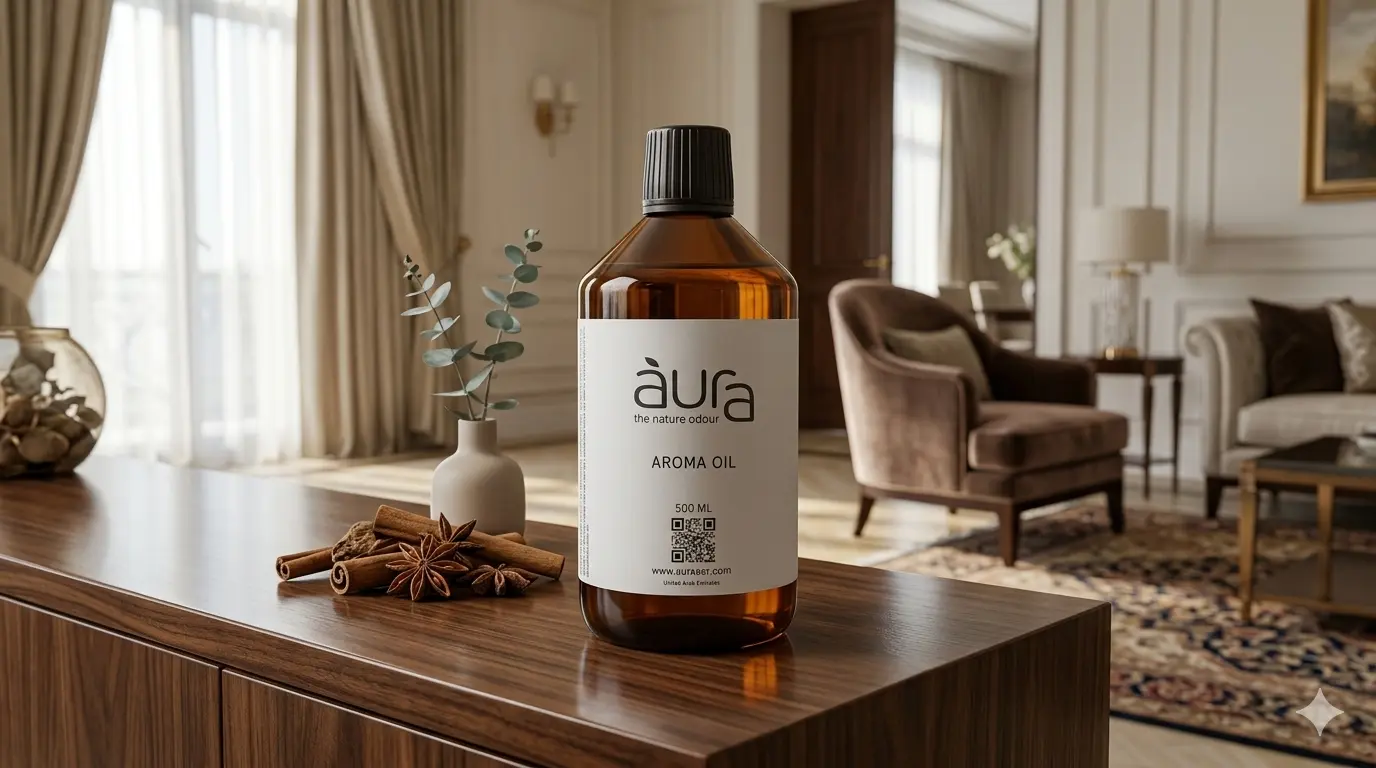
There is a version of this story most diffuser owners know personally.
You buy a fragrance oil. The name sounds promising — “Arabian Night” or “Oud Amber” or “Signature Blend.” You fill the device. You run it for an hour. The room smells fine. Pleasant enough. Recognizably scented.
But it does not smell the way you expected. It does not smell the way the hotel you stayed at last month smelled. It does not have the depth or the presence or the quality you were reaching for when you bought it.
The device is the same. The technology is the same. The experience is entirely different.
The oil is where that difference lives. And the gap between a standard diffuser oil and a professionally formulated luxury oil is wider than most people realize, not just in price, but in how they are made, what they contain, and what they actually do to a space.
What Standard Diffuser Oils Actually Are
Most fragrance oils sold for home diffuser use are produced to a mass-market price point. The economics are straightforward the lower the raw material cost, the higher the margin.
The result is an oil that is primarily composed of synthetic aromatic compounds — laboratory-created molecules that replicate the smell of natural ingredients at a fraction of the cost. A synthetic oud note. A synthetic rose. A synthetic sandalwood.
There is nothing inherently wrong with synthetic aromatic compounds. The fragrance industry uses them extensively even in luxury perfumes. The problem is the ratio and the quality of the synthesis.
Mass-market diffuser oils typically use low-grade synthetic compounds at high concentrations to produce an immediately striking smell that photographs well for marketing purposes. The first impression is strong. The dry-down — the way the scent evolves over time as different molecular weights disperse into the air — is often flat, one-dimensional, or slightly harsh.
In a cold-air diffuser, which disperses the oil at ambient temperature and preserves every layer of the fragrance profile, these quality differences are amplified rather than hidden. Cold-air atomization is unforgiving. It delivers the oil exactly as formulated. There is nowhere to hide a poorly constructed fragrance.
What Luxury Diffuser Aroma Oils Actually Are
Professional luxury fragrance oil formulation is a different discipline entirely.
The starting point is the raw material selection. Quality natural ingredients—genuine oud resin extracts, real rose absolute, and natural sandalwood isolates carry aromatic complexity that synthetic equivalents approximate but never fully replicate. The molecular profile of a genuine oud extract contains hundreds of distinct aromatic compounds. The synthetic version contains a handful.
That complexity is what produces depth. The difference between a luxury oil and a standard one is not just intensity it is the number of distinct aromatic impressions the fragrance creates as it disperses through a space. A well-formulated luxury oil has a top note the first impression when it hits the air. A heart note is the character that emerges after five to ten minutes. A base note — the warm, lingering foundation that remains in the room long after the diffuser has cycled off.
A standard oil has a smell. A luxury oil has a journey.
AuraAer’s diffuser aroma oil collection is formulated with this structure deliberately each oil in the luxury range built around a multi-note architecture designed for cold-air atomization specifically. The top notes are volatile enough to disperse immediately. The heart and base notes are formulated to the viscosity ranges that cold-air atomizers handle most effectively. The result is a fragrance that arrives, develops, and stays rather than one that simply appears and fades.
The UAE Formulation Factor
This is the element that most global fragrance brands overlook entirely and that makes locally formulated luxury oils genuinely different for UAE homes and commercial spaces.
Fragrance performance is affected by environmental conditions. Temperature, humidity, air circulation rate, and ceiling height all change how a fragrance disperses, how long it stays airborne, and how it is perceived by people in the space.
UAE interiors are specific. Air conditioning runs continuously for most of the year. Indoor humidity is consistently lower than in European or Asian markets. Ceilings are typically higher 3 to 3.5 metres in apartments, 4 metres and above in villas and commercial spaces. Air exchange rates are higher because HVAC systems are working harder.
An oil formulated for a 2.4-metre ceiling European bedroom with no air conditioning will perform differently in a 3.5-metre ceiling Dubai villa with central AC running at full capacity. The lighter top notes disperse faster in the higher air volume. The base notes may not project as far without the enclosed containment of a lower ceiling.
Luxury diffuser aroma oils formulated specifically for UAE interiors account for these variables using fragrance compounds with projection profiles suited to larger air volumes and base note structures that maintain presence in actively circulated AC air rather than settling into a still room.
This is the difference between a globally produced oil that happens to be available in the UAE and an oil that was developed for UAE conditions specifically.
The Oud Question — Where Standard and Luxury Diverge Most
Oud is the most significant point of divergence between standard and luxury diffuser oils in the UAE market because genuine oud is one of the most expensive raw materials in the global fragrance industry.
Standard oils that claim an oud profile almost universally use synthetic oud aroma chemicals. These chemicals capture the woody, slightly smoky, resinous quality of oud at a fraction of the cost of genuine oud extract. For someone unfamiliar with genuine oud, the synthetic version is convincing enough.
For anyone with Gulf cultural familiarity — for Emirati residents, for long-term UAE expats who have experienced genuine oud in homes and mosques and commercial spaces across the region — the difference is immediate and unmistakable.
Genuine oud has a warmth and complexity that synthetic versions approach but never quite reach. It has a lived-in quality — the sense that the scent is coming from something with history and character rather than a laboratory process. It develops differently over time, becoming richer rather than flatter as it fills a space.
Luxury diffuser aroma oils that use genuine oud extract — or high-quality oud isolates that preserve the natural complexity of the raw material — produce a fundamentally different experience in a UAE space. Not just better. Different in kind. The kind of difference that makes a room feel like it was designed by someone who understands what that scent means in this region.
How to Tell the Difference Before You Buy
Three practical tests that distinguish luxury formulations from standard ones without requiring a chemistry degree.
The cold sniff test Open the bottle and smell the oil directly at room temperature. A well-formulated luxury oil reveals complexity immediately—multiple distinct impressions and a sense of depth. A standard oil reveals a single dominant synthetic note with little variation.
The dry-down test Apply one drop to the inside of your wrist and evaluate it at five-minute intervals for thirty minutes. A luxury oil evolves — the character shifts as different molecular weights evaporate. A standard oil smells the same at minute one as minute thirty. Flat evolution is the signature of a simple synthetic formulation.
The diffuser performance test Run the oil in a cold-air diffuser for thirty minutes, then leave the room for fifteen minutes and re-enter. A luxury oil produces a fragrance that has distributed through the space and has depth and presence across the room. A standard oil may have a strong concentration near the device but feel thin in the rest of the space — because the fragrance compounds lack the projection profile needed for effective cold-air dispersal.
The Space the Oil Creates
There is a quality that the best-scented spaces share — a particular kind of presence that makes you feel the room was designed for how it makes you feel, not just how it looks.
That quality is not produced by expensive furniture or perfect lighting alone. It is produced by a sensory environment where every dimension — including scent — has been considered deliberately.
A luxury diffuser aroma oil, run in a correctly sized cold-air diffuser on a consistent schedule, produces a version of that quality that no standard oil achieves. Not because the technology is different. Because the oil itself has the depth to fill a space in a way that registers as designed rather than incidental.
That is the difference. Not a marketing claim. A formulation difference that you notice the moment the device starts running and keep noticing every time you walk back into the room.
Frequently Asked Questions
What is the difference between luxury diffuser aroma oils and standard diffuser oils?
Luxury diffuser aroma oils are formulated with higher-quality raw materials — genuine natural extracts, premium isolates, and multi-note fragrance architectures with distinct top, heart, and base notes. Standard diffuser oils typically use mass-market synthetic compounds at a single concentration, producing a flat, one-dimensional fragrance that does not evolve over time. In cold-air diffusers, which deliver oil exactly as formulated with no heat modification, this quality difference is immediately apparent.
Are luxury diffuser aroma oils worth the higher price?
For cold-air diffusion specifically — yes. Cold-air atomisation preserves the complete fragrance profile of the oil, amplifying both the quality of good formulations and the weaknesses of poor ones. A luxury oil in a cold-air diffuser produces a multi-layered, evolving fragrance that fills a space with depth and presence. A standard oil in the same device produces a simpler, flatter result. The price difference is justified by the formulation complexity and the performance difference in actual use.
Do luxury diffuser aroma oils contain real oud?
Quality luxury diffuser aroma oils formulated for the UAE market use genuine oud extracts or high-quality natural oud isolates not purely synthetic oud aroma chemicals. Genuine oud has aromatic complexity that synthetic equivalents approximate but do not fully replicate particularly relevant for UAE and Gulf residents with cultural familiarity with natural oud. The difference between genuine oud extract and synthetic oud is immediately recognizable to anyone familiar with traditional Gulf scenting.
Why do luxury diffuser oils perform better in UAE homes specifically?
Luxury diffuser aroma oils formulated for UAE conditions account for the specific variables of UAE interiors — higher ceilings, continuously running AC, lower indoor humidity, and higher air exchange rates. These conditions affect fragrance dispersal significantly. Oils formulated for European or Asian market conditions perform differently in UAE’s climate-controlled, large-volume interiors. UAE-specific luxury formulations use fragrance compounds with projection profiles suited to larger air volumes and base note structures that maintain presence in actively circulated AC air.
How can I tell if a diffuser aroma oil is luxury quality before buying?
Three tests help distinguish luxury from standard formulations. First cold sniff the oil directly: luxury oils reveal multiple distinct impressions and depth at room temperature. Second apply a drop to your wrist and evaluate every five minutes for thirty minutes: luxury oils evolve and develop while standard oils smell identical throughout. Third — run it in a cold-air diffuser and re-enter the room after fifteen minutes: luxury oils distribute through the full space with presence while standard oils concentrate near the device.