

Working from home in the UAE sounds like an ideal arrangement until you actually try to do focused work in a space that was designed for rest.
The problem is not willpower. It is an environment.
Your brain builds associations between spaces and states over years of repeated experience. The bedroom is for sleep. The sofa is for unwinding. The kitchen is for meals and conversation. When you try to do cognitively demanding work in these spaces, you are working against deeply conditioned associations that your nervous system has been reinforcing for as long as you have lived in that home.
Office buildings work partly because they are purpose-built spaces with no competing associations. You have never slept in your office or eaten dinner at your desk. The space signals work and your brain responds accordingly.
Creating that signal in a home environment is what most work-from-home productivity advice fails to address adequately. The standing desk tips and the morning routine guides are helpful. But they do not address the sensory environment of the home office directly.
Scent does.
Why Scent Creates Stronger Workspace Signals Than Visual Cues
Every other productivity intervention for home working operates through the visual or cognitive channel. A tidy desk. A dedicated room. A closed door. All of these send a visual signal that work is happening. They are useful.
Scent operates through a completely different pathway — directly into the limbic system, bypassing the cognitive processing layer entirely. Where a visual cue requires you to consciously register and interpret it, a scent signal arrives at the brain regions governing state and association before any conscious processing occurs.
This direct pathway is what makes scent uniquely effective for conditioning workspace associations. When a specific fragrance is consistently paired with focused work in a specific location, the fragrance eventually triggers the associated cognitive state independently. You smell the oil, and your brain begins moving toward the focused state before you have opened a single application or read a single document.
Psychologists call this a conditioned stimulus response. The mechanism is the same whether the stimulus is a sound, a visual, or a scent. But because scent has the most direct neural pathway to the association areas of the brain, it produces the strongest and fastest conditioned response of any sensory input available for this purpose.
Two weeks of consistent use is typically sufficient to establish a meaningful association. By day fourteen of running a specific oil in your home office during work sessions only, the scent alone begins to generate a cognitive shift toward the work state.
The Oils That Support Focus Specifically
Not all aromatherapy oils serve a focused purpose. The wellness applications of aromatherapy are broad, and the oils that support sleep and relaxation actively work against the alert, engaged state that focused work requires.
The right oils for a home office environment are those with documented interactions with the neurochemical pathways governing alertness, attention, and cognitive performance.
Rosemary
The strongest evidence base of any aromatic compound for cognitive performance in work settings. Research at Northumbria University found measurable improvements in memory performance and mental speed in rosemary-scented environments. The active compound 1,8-cineole inhibits acetylcholinesterase, the enzyme that breaks down acetylcholine in the brain. Acetylcholine is directly involved in sustained attention and memory formation. Inhibiting its breakdown means more acetylcholine remains available for cognitive function during a work session.
For UAE residents working from home in roles requiring reading, writing, analysis, coding, or any memory-intensive task, rosemary in the home office is the most research-supported fragrance choice available.
Lemon and citrus blends
Citrus profiles have a consistent association with improved accuracy in detail-oriented tasks. For work involving data, proofreading, financial review, or any task where precision matters more than speed, lemon and clean citrus blends produce documented improvements in error rates.
Citrus also addresses a specific problem for UAE home office workers — the sensory flatness of AC-dominated indoor air. Running a citrus oil in the afternoon session introduces a fresh sensory input that counteracts the mid-afternoon fatigue that sealed, climate-controlled interiors contribute to.
Peppermint
The alertness and anti-fatigue effects of peppermint are among the most consistently replicated findings in cognitive aromatherapy research. For morning sessions requiring high energy and fast decision-making, or for afternoon sessions when energy has dipped, peppermint provides a noticeable and fairly rapid alertness effect.
It is not a sustained focus oil in the way rosemary is. Think of it as a reset rather than a background state—most effective in shorter exposures when you need to shift mental gear rather than as an all-day ambient scent.
What does not belong in a home office
Lavender actively promotes the parasympathetic rest state. It reduces cortisol and pushes the nervous system toward recovery mode. These are exactly the properties that make it valuable for evening use and sleep — and exactly the properties that make it counterproductive in a focus environment during work hours.
Oud and heavy oriental blends carry cultural and psychological associations with rest, ceremony, and gathering that conflict with the cognitive requirements of a work session. They belong in the living area and majlis, not the home office.
Heavy florals have a consistent association with lowered alertness in research. Avoid them during work hours regardless of how pleasant they smell.
Building the Conditioned Work Signal
This is where the aromatherapy diffuser becomes genuinely powerful for home office use rather than just pleasant.
The goal is not simply to improve the scent of your workspace. It is to create a specific sensory trigger that your brain associates exclusively with focused work — so reliably that the scent alone begins to shift your cognitive state toward the work mode before you have done anything else.
To build this conditioned association correctly, three rules apply.
Rule one. Use the work oil only during work sessions.
If you run rosemary in your home office during work hours and also run it in the evening while relaxing, the association between rosemary and focused work weakens. The brain cannot build a strong conditioned response to a stimulus that appears in multiple different contexts. Reserve the work oil exclusively for work time. Switch to a different oil for the evening. The cleaner the pairing of oil and state, the faster and stronger the association develops.
Rule two. Start the diffuser before you start working.
Run the diffuser for ten to fifteen minutes before you open your laptop. This creates an anticipatory response rather than a concurrent one. The fragrance arrives before the work does. Over time the smell of rosemary begins to function as a signal that focused work is about to start, which triggers the cognitive preparation response before the first task has been addressed.
Rule three. Keep the association consistent.
Same oil. Same location. Same approximate intensity. Every work session for at least two weeks without exception. Consistency is what converts a pleasant background smell into a genuine cognitive trigger. Varying the oil or the location or running it erratically breaks the association before it has time to solidify.
After two to three weeks of consistent pairing, the association is established. The conditioned response continues to strengthen with repetition. After a month of consistent use, most people report noticing a distinct cognitive shift within two to three minutes of the diffuser starting — before the fragrance has even fully dispersed through the room.
Practical Setup for a UAE Home Office
Device sizing
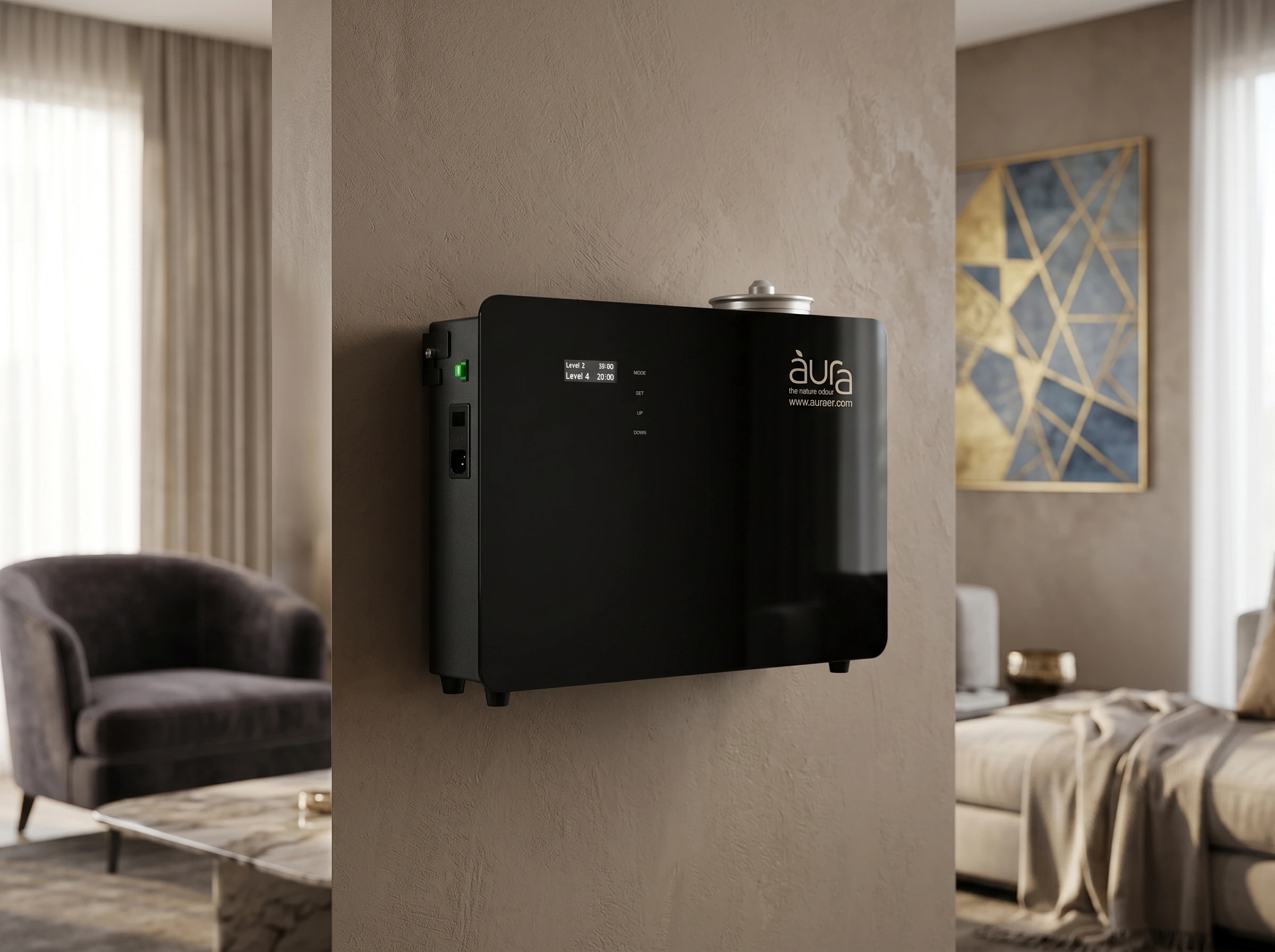
Most UAE home office spaces are between 15 and 40 square meters. A compact cold-air diffuser rated for this volume is appropriate. Running an oversized device in a small space at low intensity is less effective than a correctly sized device at optimal intensity. Check the cubic meter coverage rating of any device against your actual room volume, including ceiling height, before purchasing.
Intensity and scheduling
For home office use, 20 to 30 percent intensity on a 25-minute on and 15-minute off cycle is the recommended approach. This keeps the fragrance present enough to register without triggering olfactory adaptation through continuous exposure. The off cycle resets your receptors so the scent registers freshly at the start of each new cycle, maintaining both the pleasant experience and the cognitive trigger.
Placement
Position the diffuser on the desk or a shelf on the opposite side of the room from your seating position. The fragrance travels toward you rather than being concentrated at close range. In a small UAE home office with AC running, the airflow carries the particles across the room efficiently. Avoid positioning directly under an AC supply vent as the downward blast pushes particles toward the floor rather than allowing them to disperse at breathing height.
Managing the home-to-office transition
The physical transition from home mode to office mode is one of the hardest parts of working from home. Most productivity advice addresses this through routines—getting dressed for work, having a defined start time, and walking around the block before sitting down.
Adding the diffuser to this transition ritual accelerates the state shift significantly. Start the diffuser as the first action of your work morning. By the time you sit down at the desk, the fragrance is already in the room. The cognitive shift has already begun. The home is starting to feel like a workspace before you have opened a single document.
Frequently Asked Questions
Can an aromatherapy diffuser help with focus and concentration?
Yes for specific oils with documented cognitive mechanisms. Rosemary contains 1,8-cineole which inhibits the breakdown of acetylcholine, a neurotransmitter directly involved in sustained attention and memory. Research at Northumbria University found measurable improvements in memory performance in rosemary-scented environments. Lemon and citrus profiles show consistent improvements in task accuracy. These are neurochemical interactions rather than placebo effects from pleasant smells.
What aromatherapy oil is best for concentration when working from home?
Rosemary has the strongest evidence base for sustained focus and memory performance in work environments. Lemon and citrus blends are most effective for accuracy in detail-intensive tasks and for counteracting mid-afternoon fatigue. Peppermint suits high-alertness periods and mental reset moments rather than sustained background use. Lavender, oud, and heavy florals actively work against the focused state and should be avoided during work hours.
How long does it take for an aromatherapy diffuser to help with focus?
Immediate neurochemical effects from compounds like 1,8-cineole in rosemary begin within minutes of inhalation. The conditioned workspace association—where the scent alone triggers the focused state—takes approximately two weeks of consistent daily pairing between the oil and work sessions to establish. After two to three weeks, most people report noticing a distinct cognitive shift within two to three minutes of the diffuser starting.
Should I use the same oil every day for my home office?
Yes, if the goal is to build a conditioned workspace association. Using the same oil exclusively during work sessions trains your brain to associate that specific scent with the focused work state. Varying the oil or using it outside work hours weakens the association. Consistency of oil, location, and approximate intensity across all work sessions is what converts a pleasant background smell into a reliable cognitive trigger.
How do I set up an aromatherapy diffuser in a home office in UAE?
Use a cold-air diffuser sized for your room volume—most UAE home offices need a compact unit for 15 to 40 square meters. Position it on a desk or shelf on the opposite side of the room from your seating position at a height of 80 centimeters to 1.2 meters. Run at 20 to 30 percent intensity on a 25-minute on and 15-minute off cycle. Start the diffuser ten to fifteen minutes before beginning work so the fragrance is already in the room when you sit down.
Is it safe to run an aromatherapy diffuser all day while working from home?
Continuous operation is less effective than cycle scheduling and wastes oil without improving results. After fifteen to twenty minutes of continuous exposure, olfactory adaptation reduces your conscious perception of the scent. A 25-minute on and 15-minute off cycle maintains the cognitive trigger by resetting your olfactory receptors during the off period. For people with respiratory sensitivities, starting at 15 to 20 percent intensity and adjusting based on comfort is recommended.