

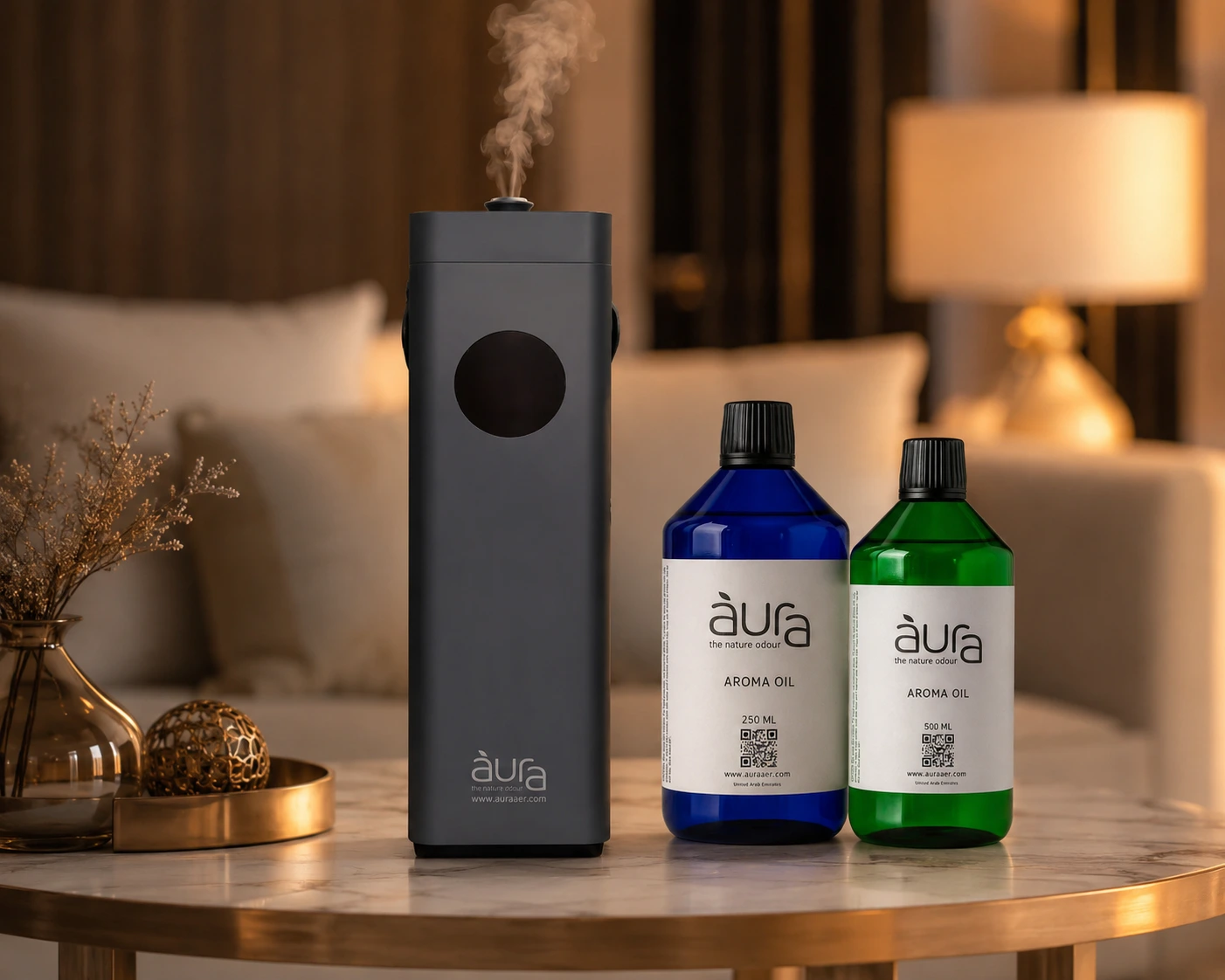
Walk into any home fragrance shop in Dubai Mall or browse any online store in the UAE and you will find two types of diffusers sitting next to each other on the shelf.
One is cheaper. One produces visible mist. One has a glowing light and a satisfying bubbling sound. That one sells more.
The other one looks like a small metal appliance. No water. No mist. No light show. Costs more. Sells to people who have already tried the first one and want something that actually works.
This is the cold-air vs ultrasonic conversation. And if you are trying to decide between them for your UAE home, office, or commercial space — the answer is not complicated once you understand what each one is actually doing.
What an Ultrasonic Diffuser Is Actually Doing
An ultrasonic diffuser has a water tank. You fill it, add several drops of oil, and an ultrasonic plate at the base vibrates at a high frequency. Those vibrations break the water into a cool mist, which you can see rising from the top of the device.
The visible mist is almost entirely water. The oil is a small fraction of what you are seeing. What reaches the air in your room is a water-heavy, oil-light mixture that behaves like humidity—it settles, it evaporates, and in a UAE home with air conditioning running, it gets cycled through the ventilation system before it has had time to properly disperse.
The result is a scent that is present near the device, detectable within one to two meters, and largely absent anywhere further than that in a normally sized UAE room.
Ultrasonic diffusers work. In the right context — a small, enclosed room with no AC running, used for short sessions — they are a reasonable and affordable option. The problem is that this description does not match most UAE homes.
What a Cold-Air Diffuser Is Actually Doing
A cold-air diffuser has no water tank. It has an oil reservoir.
Inside the device, a small air compressor generates a pressurized stream of air. That airstream passes through an atomizer containing pure fragrance oil. The physics of the airflow — the Bernoulli effect — pulls the oil upward and breaks it into particles measured in microns. These particles are dry. They weigh almost nothing. They stay suspended in the air for an extended period rather than settling or evaporating quickly.
No water. No heat. No humidity added to the room. Just pure oil — broken into particles fine enough to travel through the air and remain there.
In a UAE home where air conditioning is continuously cycling the indoor air, those nanoparticles integrate with the airflow rather than being disrupted by it. The AC becomes the distribution system. A correctly sized cold-air diffuser fills its rated coverage area consistently—including the far corners of an open-plan living room, the upstairs landing of a villa, and the reception area of an office.
This is the mechanism used in every five-star hotel lobby in Dubai. Not because hotels have bigger budgets for luxury items—because it is the only technology that reliably works at scale in a climate-controlled environment.
The Direct Comparison — Five Factors That Matter in UAE
Coverage area
Ultrasonic diffusers are typically rated for 20 to 40 square meters under ideal conditions. In a UAE home with AC running, the effective coverage is closer to 10 to 20 square meters. A standard UAE apartment living room is 30 to 50 square meters. A villa living area is often 80 to 150 square meters.
Cold-air diffusers are rated for 200 to 1,500 square meters depending on the model. The coverage rating is based on cubic meter air volume—which accounts for the UAE’s higher ceilings—and tested under real operating conditions, including air circulation.
Scent fidelity
Ultrasonic diffusers dilute the oil with water before dispersing it. The fragrance concentration in the air is a fraction of what the oil is capable of. The scent profile you experience is a diluted, water-mediated version of the oil.
Cold-air diffusers disperse pure undiluted oil. The fragrance that reaches your nose is chemically identical to what is in the reservoir. The top notes, heart notes, and base notes arrive in the correct proportions—the way the oil was formulated.
Humidity
Ultrasonic diffusers add measurable humidity to indoor air. In a UAE home where AC is managing humidity continuously, this creates additional load on the air conditioning system. The AC has to remove the moisture the diffuser is adding, which means slightly higher energy consumption and slightly less comfortable air.
Cold-air diffusers add zero humidity to the air. They have no effect on indoor humidity levels whatsoever. In the UAE’s AC-dominated indoor environment, this is a practical advantage that ultrasonic diffusers cannot match.
Oil consumption
Ultrasonic diffusers use oil slowly because most of what is dispersed is water. A 10ml bottle of oil might last two weeks in an ultrasonic device.
Cold-air diffusers use pure oil with no dilution. Oil consumption is higher per session—but because they cover larger areas and operate on efficient cycle schedules via app control, the cost per square meter of effective coverage is comparable.
Maintenance
Ultrasonic diffusers require regular cleaning of the water tank. Water sitting in a warm device grows bacteria and mold if not cleaned every three to five days. The ultrasonic plate degrades over time with mineral deposits from tap water—UAE tap water has high mineral content, which accelerates this.
Cold-air diffusers have no water components to clean. The atomizer requires occasional maintenance but does not accumulate bacteria, mold, or mineral deposits.
Which One Is Right for You
Choose an ultrasonic diffuser if:
- You want to spend AED 50 to 150 on a first diffuser to try aromatherapy
- The room is small under 20 sqm and mostly enclosed
- You do not run AC in that room during the session
- You are comfortable cleaning the tank every few days
Choose a cold-air diffuser if:
- You want genuine room coverage in a UAE apartment, villa, or office
- Your AC runs during diffuser use—which in the UAE is most of the time
- You want the fragrance to match the oil you bought—not a diluted version
- You want a device that lasts years with minimal maintenance
- You want the same technology used in the hotels and commercial spaces you admire
The honest summary: ultrasonic diffusers are an entry point. Cold-air diffusers are the actual solution. Most people who own an ultrasonic diffuser and switch to a cold-air unit describe the experience as realizing their previous device was not really working.
Explore AuraAer’s full range of aromatherapy diffuser models with cold-air nano-diffusion technology built for UAE homes, offices, and commercial spaces alongside diffuser aroma oil and diffuser oil collections formulated specifically for cold-air atomization.
Frequently Asked Questions.
What is the difference between a cold-air diffuser and an ultrasonic diffuser?
An ultrasonic diffuser mixes oil with water and uses vibration to produce a cool mist—the oil is diluted and coverage is limited. A cold-air diffuser uses pressurized air to atomize pure fragrance oil into dry nanoparticles with no water and no heat. Cold-air diffusion covers larger areas, preserves the oil’s complete fragrance profile, adds no humidity to the air, and performs significantly better in air-conditioned UAE environments.
Which diffuser is better for UAE homes — cold-air or ultrasonic?
Cold-air diffusers are better suited to UAE homes for three reasons. First, UAE homes run air conditioning continuously—cold-air nanoparticles integrate with AC airflow while ultrasonic mist gets disrupted by it. Second, UAE living spaces are typically larger than European apartments—cold-air diffusers cover 200 to 1,500 sqm versus ultrasonic’s 20 to 40 sqm. Third, cold-air diffusers add no humidity—important in a climate where AC is managing indoor humidity year-round.
Do ultrasonic diffusers work with air conditioning running?
Partially. Ultrasonic diffusers produce a water-heavy mist that is affected by AC airflow. The mist gets pulled into the ventilation return before fully dispersing, reducing effective coverage significantly. In small enclosed rooms with minimal AC flow, ultrasonic diffusers perform adequately. In typical open-plan UAE apartments and villas with central AC running continuously, coverage is noticeably reduced compared to cold-air alternatives.
Why do hotels use cold-air diffusers instead of ultrasonic?
Scale and performance. Hotel lobbies, corridors, and guest rooms require consistent fragrance coverage across thousands of square meters simultaneously. Ultrasonic diffusers cannot achieve this—their coverage is too limited and their mist too easily disrupted by HVAC systems. Cold-air diffusion integrates with HVAC infrastructure, distributing dry nanoparticles through existing ductwork to every area the ventilation serves. It is the only technology that delivers consistent whole-property scenting.
Are cold-air diffusers more expensive to run than ultrasonic?
The device purchase price is higher. Running costs are comparable. Cold-air diffusers use pure oil, which costs more per session than the small amounts of oil used in an ultrasonic device—but they cover dramatically larger areas, require no water, and run on efficient cycle schedules that extend oil life. When calculated as cost per square meter of effective coverage, cold-air diffusers are comparable or better value than ultrasonic alternatives in UAE-sized rooms.
Can I use essential oils in a cold-air diffuser?
Yes, cold-air diffusers are designed specifically for pure, undiluted fragrance oil or essential oil. Unlike ultrasonic diffusers, which require oil to be mixed with water first, cold-air diffusers atomize the oil directly with no dilution required. The oil must be formulated for cold-air atomization—low viscosity, no carrier oil base, and no water content. AuraAer’s diffuser aromatherapy oil range is formulated specifically for cold-air diffusion systems.