

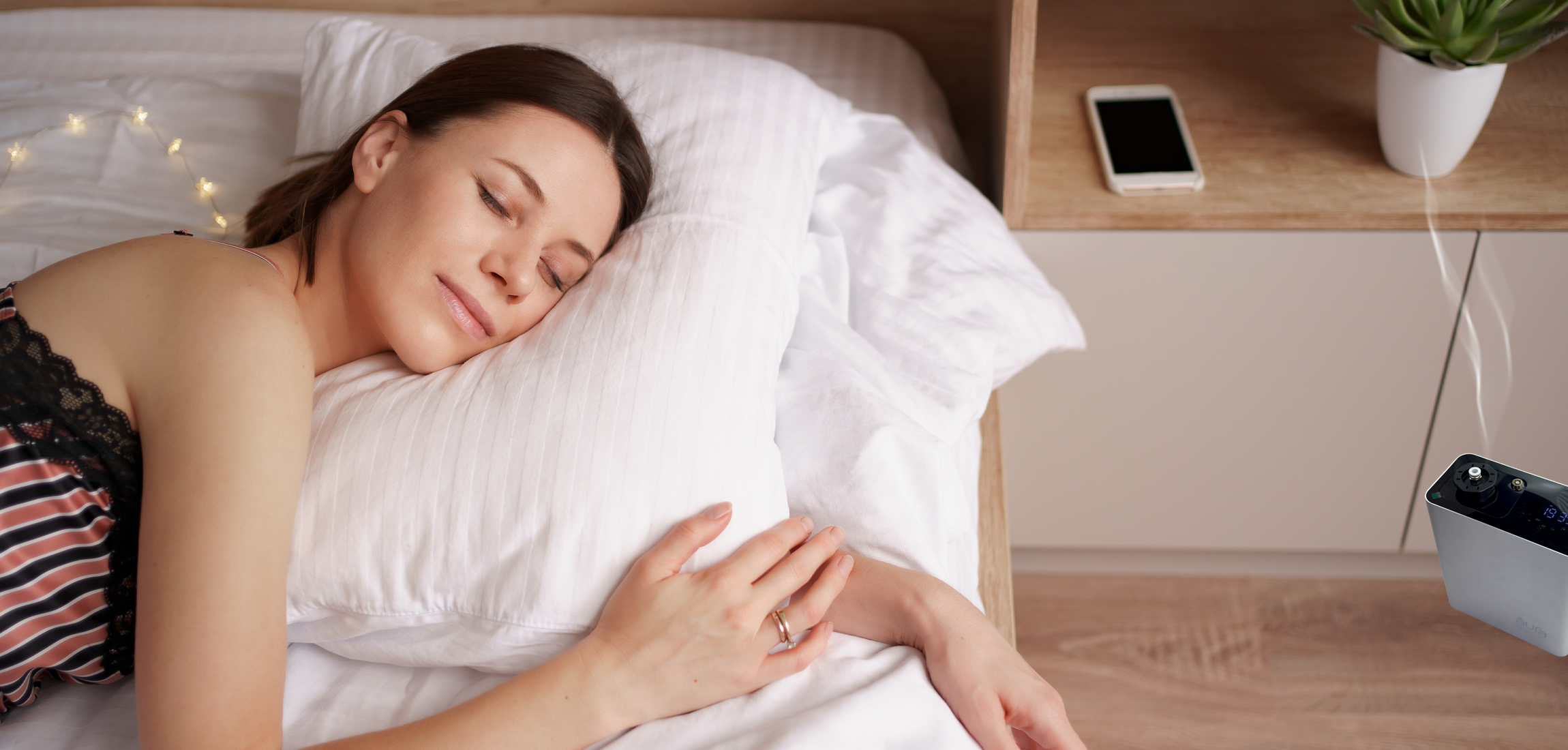
Sleep is one of those things that UAE residents genuinely struggle with more than they admit.
The combination of late evenings, bright city lights, the constant hum of AC, irregular schedules, and the pressure of a fast-moving city means that by the time most people in Dubai or Abu Dhabi actually get into bed their mind is still running at full speed.
Scrolling helps for a few minutes. Then it makes it worse. A heavy meal at 10pm does not help. And the idea of a full eight hours feels increasingly theoretical.
What most people have not tried — seriously tried, with consistency — is using an aromatherapy diffuser as a deliberate part of their night routine. Not as a nice-to-have. As an actual tool.
This guide explains exactly how to do it.
Why Scent Is One of the Most Powerful Sleep Triggers Available
Most sleep advice focuses on light, temperature, and screen time. All valid. But scent gets overlooked almost entirely, which is strange because it is the only sense with a direct neural pathway to the limbic system, the part of the brain that controls emotional regulation, stress response, and the transition into sleep states.
Every other sensory input — light, sound, touch — routes through other brain regions first before reaching the areas that govern sleep. Scent arrives directly.
This is why a specific fragrance can trigger a memory or an emotional state almost instantly. The neural pathway is short and direct. And it is also why deliberately introducing a calming scent into your sleep environment—consistently, every night—has a measurable effect on how quickly you fall asleep and how deeply you stay asleep.
It is not a placebo. Multiple clinical studies on lavender specifically show reduced sleep latency, increased slow-wave sleep, and lower heart rate during the night. The mechanism is real.
The Three Oils That Actually Work for Sleep
Not all oils are equally effective for sleep. Here are the three with the strongest evidence base and the most consistent results in real-world use.
Lavender — the most studied and most reliable
Lavender contains linalool and linalyl acetate — compounds that interact with GABA receptors in the brain, producing a mild sedative effect without drowsiness the following morning. It is the most researched aromatherapy oil for sleep, and the results across studies are consistent enough to take seriously.
For UAE homes specifically, French or Bulgarian lavender works well in cold-air diffusion — the scent profile is clean and floral without being heavy, which suits the dry indoor air of an AC-cooled bedroom.
Roman Chamomile — for anxiety-driven sleeplessness
If the reason you cannot sleep is that your mind will not stop — racing through tomorrow’s meetings, replanning conversations, running through lists — Roman chamomile is more effective than lavender. It has a warm, slightly apple-like scent and is particularly effective for the kind of stress-related sleeplessness that is common among professionals in Dubai.
Cedarwood — for deep sleep maintenance
Cedarwood contains cedrol, a compound that research links to reduced wakefulness during the night and more time spent in deep sleep stages. If you fall asleep fine but wake at 2am or 3am and cannot get back to sleep — cedarwood is the oil to try. It is also a grounding, earthy scent that pairs well with lavender as a blend.
How to Use Your Aromatherapy Diffuser for Sleep — The Exact Routine
Consistency matters more than any individual session. Here is the routine that produces results.
60 minutes before bed — start the diffuser
Do not wait until you are in bed to turn on the diffuser. The goal is to have the fragrance already present in the room when you enter it. Set your aromatherapy diffuser to start running 60 minutes before you plan to sleep.
Use lavender or a lavender-cedarwood blend. Run it at 40 to 50% intensity — strong enough to scent the room but not so intense that it becomes the dominant sensory experience.
The routine during that 60 minutes
This is where the conditioned response gets built. Your brain is remarkably good at associating a sensory input with a state — but only if the association is consistent. Do the same things in the same order every night while the diffuser runs.
Dim the lights. Put your phone on silent and face down. Take a shower if that is part of your routine. Read something non-stimulating. The specific activities matter less than their consistency. The scent becomes the anchor that signals to your nervous system — this is what we do before sleep.
After two weeks of this routine, the moment the lavender scent reaches you, your body starts preparing for sleep. The diffuser is doing the neurological conditioning work in the background.
Set a 90-minute timer on the diffuser
You do not need the diffuser running all night. The AuraAer range connects via Bluetooth and Wi-Fi — set a 90-minute timer through the app before you get into bed. The diffuser runs through your wind-down period and for the first 30 to 40 minutes after you fall asleep, then switches off automatically. The residual particles in the air continue delivering fragrance for another 30 to 60 minutes after the device stops.
You get the full sleep benefit without running the device overnight or consuming unnecessary oil.
Keep the intensity lower than you think
This is the most common mistake with bedroom diffusers. People run them too strong. A bedroom is a small space and a cold-air diffuser at full intensity in a sealed room is overkill. Start at 30% intensity and adjust upward only if you genuinely cannot detect the scent. Less is more in a bedroom environment.
What to Expect — And When
Night 1 to 3: The scent is pleasant. You notice it. Your room smells different — better. Sleep may or may not improve immediately. This is normal.
Night 4 to 7: The association between the scent and the transition to sleep starts building. Most people notice they feel more relaxed faster after getting into bed. The mind-racing that characterises difficulty sleeping starts to ease somewhat.
Night 8 to 14: The conditioned response is establishing itself. Many people report that they start to feel sleepy when they smell the diffuser starting up — before they have even gotten into bed. This is the neurological association working exactly as intended.
Night 15 onwards: The routine is set. The diffuser is no longer something you are trying — it is just part of how you sleep. This is where the compounding benefit of consistency becomes real.
A Note on UAE Bedroom Conditions
UAE bedrooms present one specific challenge for sleep that is worth addressing the AC.
Most UAE bedrooms run AC continuously through the night, which creates very dry air. Dry air can cause mild throat and nasal irritation that disrupts sleep quality particularly for people who sleep with their mouth open or have mild sinus sensitivity.
This is where eucalyptus oil as an occasional addition to your sleep blend is useful. A small amount of eucalyptus — 20% of the blend maximum — supports comfortable breathing in dry AC air. It is not a sleep oil in the way lavender is, but it addresses a UAE-specific condition that affects sleep quality.
A blend of 70% lavender, 10% cedarwood, and 20% eucalyptus works well for UAE bedroom conditions specifically. Use premium aroma oils formulated for cold-air diffusion the purity of the oil directly affects the quality of the therapeutic experience.
A Note on UAE Bedroom Conditions
UAE bedrooms present one specific challenge for sleep that is worth addressing the AC.
Most UAE bedrooms run AC continuously through the night, which creates very dry air. Dry air can cause mild throat and nasal irritation that disrupts sleep quality particularly for people who sleep with their mouth open or have mild sinus sensitivity.
This is where eucalyptus oil as an occasional addition to your sleep blend is useful. A small amount of eucalyptus — 20% of the blend maximum — supports comfortable breathing in dry AC air. It is not a sleep oil in the way lavender is, but it addresses a UAE-specific condition that affects sleep quality.
A blend of 70% lavender, 10% cedarwood, and 20% eucalyptus works well for UAE bedroom conditions specifically. Use premium aroma oils formulated for cold-air diffusion the purity of the oil directly affects the quality of the therapeutic experience.
An aromatherapy diffuser does not knock you out. It is not a sleeping pill. What it does is create the consistent sensory conditions that allow your nervous system to shift from alert to relaxed which is the transition that sleep-deprived people struggle with most.
Used consistently, with the right oils, in the right room, at the right intensity it works. Not overnight. Over two weeks.
That is a reasonable investment for something that improves one of the most important parts of your day.
Frequently Asked Questions About Aromatherapy Diffusers and Aroma Oils
Can an aromatherapy diffuser help with sleep?
Yes. Aromatherapy diffusers running specific oils — particularly lavender, Roman chamomile, and cedarwood — have consistent research support for improving sleep quality. Lavender specifically reduces sleep latency and increases slow-wave sleep through its interaction with GABA receptors. Used consistently as part of a nightly routine, an aromatherapy diffuser builds a conditioned neurological response that makes the transition to sleep easier over time.
Which aromatherapy oil is best for sleep?
Lavender is the most researched and most reliable oil for sleep; it reduces the time taken to fall asleep and improves sleep depth. Roman chamomile is more effective for anxiety-driven sleeplessness, where the mind races at bedtime. Cedarwood helps with sleep maintenance, reducing midnight waking. A blend of lavender and cedarwood covers both falling asleep and staying asleep effectively.
How long should I run an aromatherapy diffuser before bed?
Start the diffuser 60 minutes before you plan to sleep so the fragrance is already present when you enter the bedroom. Set a 90-minute timer so the device runs through your wind-down period and the first 30 minutes after you fall asleep, then switches off automatically. You do not need the diffuser running all night — cold-air particles remain suspended in the air for 30 to 60 minutes after the device stops.
Where should I place my aromatherapy diffuser in the bedroom?
Place the diffuser on a nightstand or dresser at least one metre away from your pillow — not directly beside your head. Position it away from the AC vent so the airflow distributes the fragrance through the room rather than blowing it in one direction. The centre of the room or opposite the AC return vent gives the most even fragrance distribution.
Is it safe to run an aromatherapy diffuser all night in a UAE bedroom?
It is safe but unnecessary. Running a cold-air diffuser for 90 minutes on a timer delivers the full sleep benefit without continuous overnight operation. UAE bedrooms with AC running all night already have dry, recirculated air — running a diffuser continuously for 8 hours is more oil than needed for the therapeutic benefit. A 90-minute timer set before bed is the recommended approach.
How long does it take for aromatherapy to improve sleep?
Most people notice a relaxation effect from the first session. Consistent sleep improvement — falling asleep faster and waking less — typically develops after 7 to 14 days of nightly use. This is because the brain builds a conditioned association between the scent and the sleep state over repeated sessions. The benefit compounds with consistency rather than appearing immediately.