

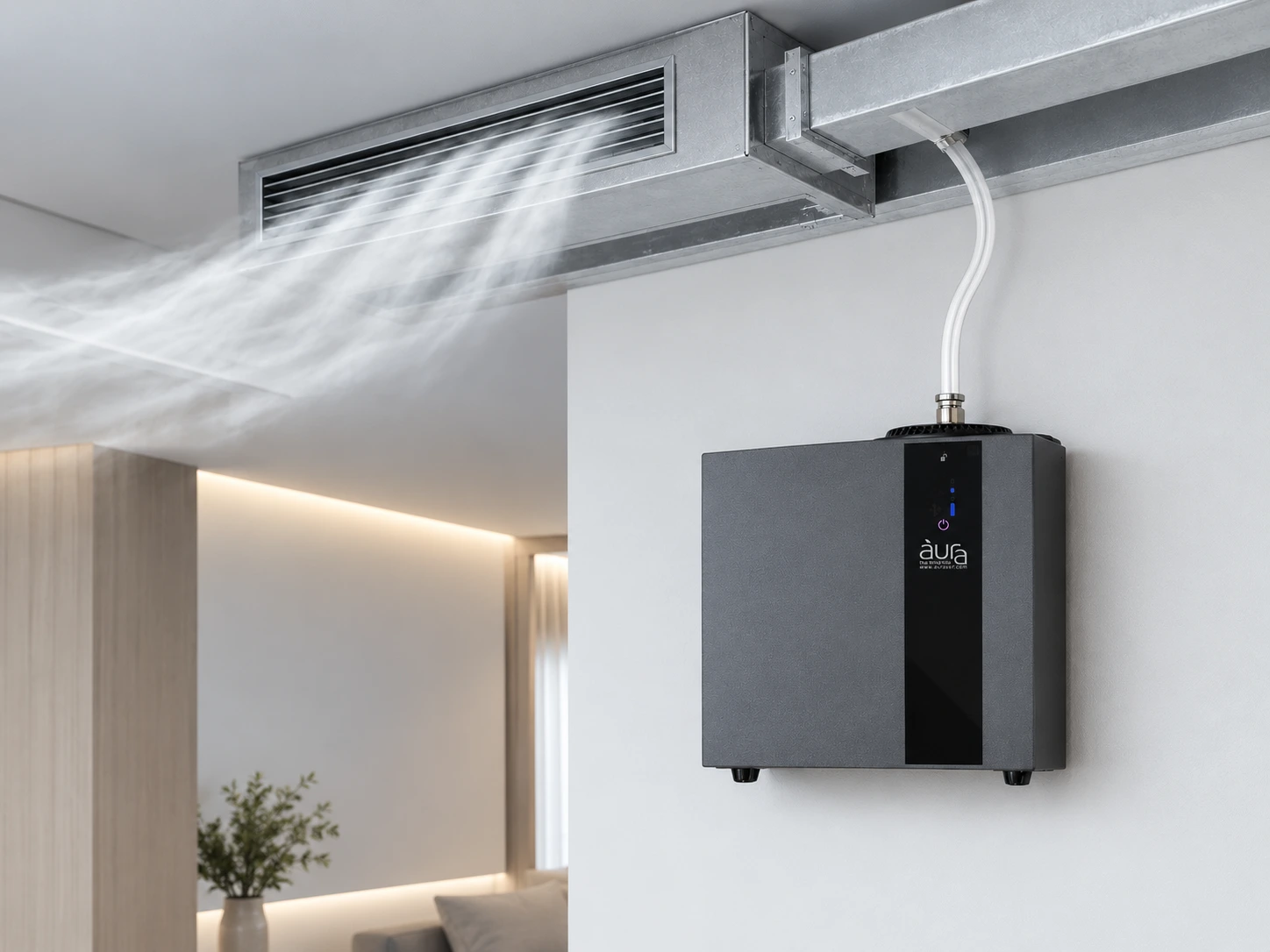
Every large scented space you have walked through in the UAE was scented through the air conditioning system.
Hotel lobbies, mall common areas, airport lounges, corporate reception floors. None of them achieve consistent coverage with units sitting on furniture. The fragrance is introduced into the air handling infrastructure and distributed by the same system that moves conditioned air through the building.
This is a different engineering approach from standalone diffusion, and the circumstances where it makes sense are narrower than the suppliers promoting it usually suggest.
What HVAC integration physically involves
A diffusion unit is installed at the air handling unit, or on the supply duct downstream of it, rather than in the occupied space.
The unit atomises oil into the airstream as conditioned air passes through. That air then travels through the existing duct network and emerges from every supply vent connected to that zone, carrying fragrance with it.
The building’s own ventilation becomes the distribution mechanism. No individual room needs its own device because every room served by that air handler receives fragrance simultaneously.
The equipment itself is similar in principle to a standalone cold air unit. Pressurised air, pure oil, dry particles measured in microns. What differs is the injection point and the scale of the air volume being treated.
Why this only works with dry particle diffusion
The technology constraint is absolute and worth understanding.
Duct systems move air at speed through sheet metal passages, often over considerable distances, with changes in direction and velocity along the way.
Dry micron sized particles survive that journey. They remain suspended in the moving air and travel the full distance to the supply vents.
Mist or vapour does not. Water based output condenses on duct surfaces, which deposits fragrance inside the ductwork rather than delivering it to the space, introduces moisture into a system designed to remove it, and creates conditions for microbial growth in exactly the place no one wants it.
This is why HVAC scenting is exclusively a cold air application. No other diffusion technology is viable in duct integration, which is the reason commercial scenting standardised on it long before residential products did.
Where UAE conditions make this particularly effective
Three local factors favour duct integration more than they would in most markets.
Continuous operation. UAE air handling runs year round at substantial throughput. The distribution mechanism is always active, which means fragrance delivery is consistent rather than dependent on seasonal ventilation patterns. In a temperate market where HVAC runs intermittently, duct scenting delivers intermittently.
Sealed building envelopes. Minimal infiltration from outside means the treated air stays within the system longer and the fragrance concentration is more predictable. Buildings with significant natural ventilation lose fragrance continuously through uncontrolled openings.
Zone architecture. Large UAE commercial buildings are typically designed with multiple air handling zones serving different floors or functional areas. That zoning allows different fragrance profiles or intensities in different parts of a building, which would be difficult to achieve with standalone units and impossible with a single centralised system in a building without zoning.
Where it is the wrong approach
Being direct about this, because duct integration is frequently proposed where it does not belong.
Residential apartments. The air handling in a typical UAE apartment is a single fan coil unit or a small split system serving one or two rooms. Integration offers no coverage advantage over a standalone device, adds installation cost and complexity, and removes the ability to run different profiles in different rooms. A standalone scent diffuser per zone is both cheaper and more flexible.
Spaces needing different scents in adjacent areas. If a venue wants one profile in the restaurant and another in the spa, and both are served by the same air handler, duct integration cannot deliver it. Standalone units can.
Rented premises without landlord approval. Any work on building HVAC infrastructure requires authorisation, and in many UAE commercial leases the air handling plant is explicitly outside the tenant’s scope. Standalone units require no permission.
Buildings with shared air handling across tenancies. Introducing fragrance into an air handler serving multiple commercial units affects everyone connected to it. This is both a technical and a relationship problem.
The practical requirements
For projects where integration is appropriate, four things determine feasibility.
Access to the air handling unit or supply duct. Physical access for installation and ongoing maintenance, including oil refills. A unit installed in a plant room that requires a facilities escort every two weeks creates an operational burden that undermines the system.
Airflow rate. The volume of air moving through the duct determines the injection rate required. This is a design calculation rather than a guess, and getting it wrong produces either imperceptible fragrance or an overwhelming one.
Zone mapping. Understanding which spaces are served by which air handler, which determines what gets scented and what does not.
Facilities coordination. Building management needs to know the system exists, what it contains, and who maintains it. Retrofitting anything into HVAC infrastructure without that coordination creates problems during routine maintenance.
Maintenance differences
Duct integrated systems are lower touch than standalone units in daily terms and higher touch in scheduled terms.
Daily operation requires nothing. There is no device in the occupied space to interact with, and scheduling runs automatically alongside the HVAC programme.
Scheduled maintenance requires plant room access. Oil reservoirs are typically larger than residential units and refill intervals correspondingly longer, but the refill itself involves coordination rather than walking into a room with a bottle.
Atomiser cleaning follows the same principles as any cold air system, isopropyl alcohol to clear oil residue, but again requires access rather than being a casual task.
The practical implication is that duct systems suit organisations with facilities management capability and suit poorly where nobody owns responsibility for building services.
Choosing between the two approaches
The question is not which technology is better. Both use the same mechanism.
Duct integration suits large spaces with substantial air handling, uniform fragrance requirements across the served area, available plant access, and an organisation with facilities capability.
Standalone units suit smaller spaces, requirements that differ between adjacent areas, rented premises, and any situation where flexibility matters more than centralisation.
Most UAE commercial projects of moderate size end up with standalone units, not because duct integration is inferior but because the conditions that make it advantageous are specific to larger buildings with dedicated facilities teams.
Frequently Asked Questions
How does HVAC scent diffusion work?
A diffusion unit is installed at the air handling unit or on the supply duct, atomising oil into the airstream as conditioned air passes through. That air carries the fragrance through the existing duct network and out through every supply vent connected to the zone. The building’s ventilation becomes the distribution mechanism, so every room served by that air handler receives fragrance simultaneously without needing individual devices.
Can any diffuser be connected to an HVAC system?
No. Only dry particle cold air diffusion is viable in duct integration. Water based mist condenses on duct surfaces, depositing fragrance inside the ductwork rather than delivering it to the space, introducing moisture into a system designed to remove it, and creating conditions for microbial growth. Dry micron sized particles remain suspended through the duct run and reach the supply vents intact.
Is HVAC scenting suitable for apartments?
Generally not. A typical UAE apartment is served by a single fan coil or small split system covering one or two rooms, so integration offers no coverage advantage over a standalone device while adding installation cost and complexity. It also removes the ability to run different fragrance profiles in different rooms, which most households want. Standalone units per zone are both cheaper and more flexible at residential scale.
What is required to install HVAC scent diffusion in a UAE building?
Physical access to the air handling unit or supply duct for installation and ongoing maintenance, a calculated injection rate matched to the airflow volume moving through the duct, zone mapping to establish which spaces are served by which air handler, and coordination with building facilities management. In rented premises, landlord authorisation is required since HVAC plant is typically outside the tenant’s scope.
Why do UAE buildings suit HVAC scenting particularly well?
Air handling runs continuously year round at substantial throughput, so the distribution mechanism is always active rather than seasonal. Sealed building envelopes mean minimal infiltration from outside, keeping treated air within the system longer and fragrance concentration more predictable. Large UAE commercial buildings are also commonly designed with multiple air handling zones, allowing different profiles or intensities across different parts of a building.