

Almost nobody knows whether their diffuser is using oil at a reasonable rate, because there is nothing to compare it against.
A bottle empties. Was that fast? Slow? Normal for the settings? Without a benchmark the question is unanswerable, which is why most people only notice consumption when it changes suddenly, and by then they have lost the reference point that would explain why.
Here is what the numbers actually look like.
The four variables
Consumption is determined by four things, and only one of them is the device.
Intensity setting is the largest factor by a wide margin. Output scales roughly with the setting, so running at sixty percent uses approximately double what forty percent uses over the same period. This is where most unexpected consumption originates.
Run time is the second. Total hours the device is actively atomising, not hours the device is switched on. A unit on a cycle schedule of twenty five minutes on and fifteen off is atomising for around sixty two percent of its switched on time.
Room volume matters indirectly. A larger room usually requires a higher intensity setting to achieve the same perceived result, so the volume drives the setting rather than the consumption directly.
Oil viscosity has a smaller but real effect. Thicker oils atomise less efficiently, which means more oil is drawn for fewer airborne particle, and typically a higher setting to compensate.
What normal looks like
These figures assume a correctly specified device running an oil within the appropriate viscosity range.
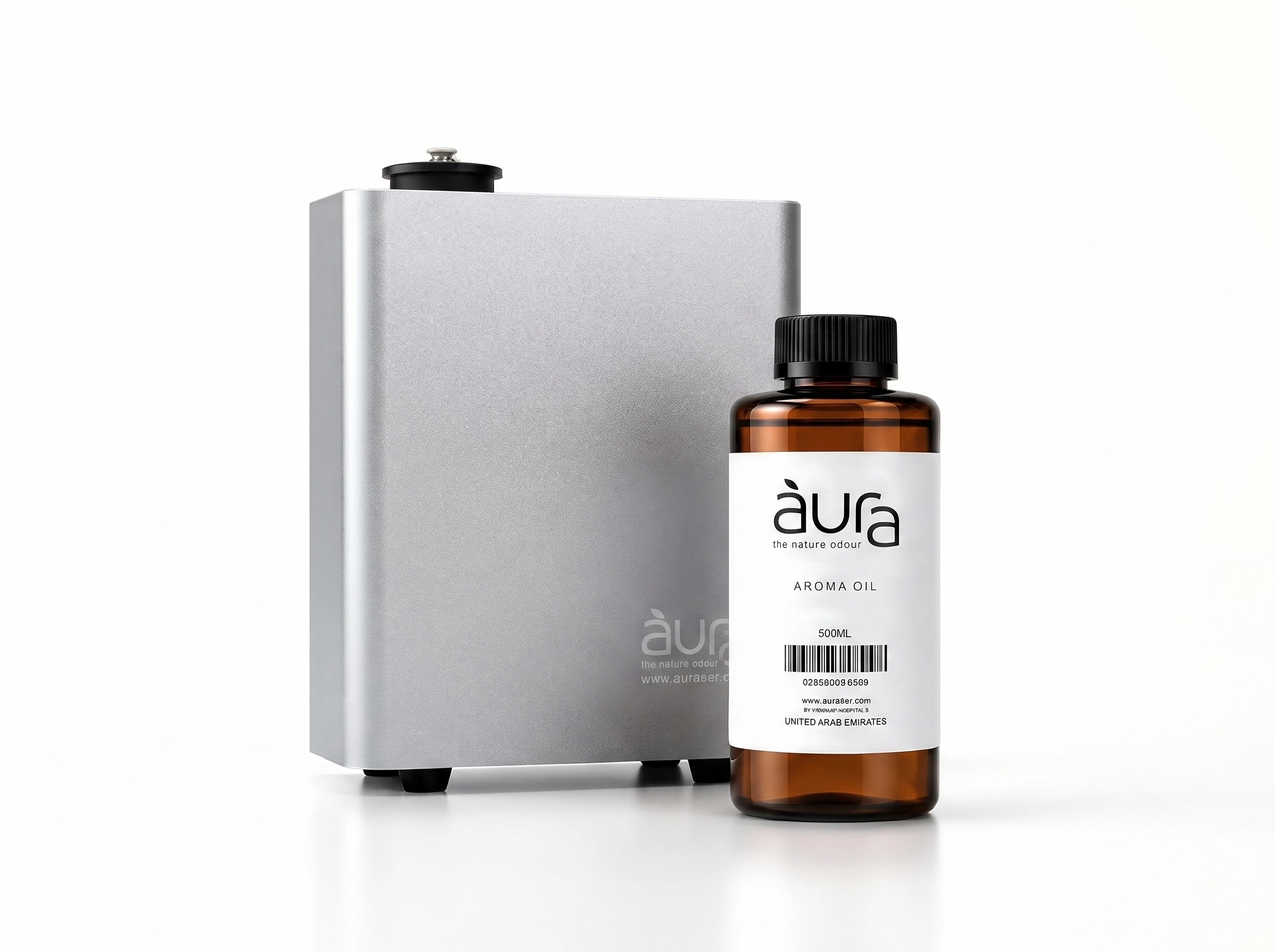
A 500 ml reservoir at thirty percent intensity, running a cycle schedule for four hours a day, typically lasts six to eight weeks.
The same reservoir at forty five percent for the same four hours lasts around four to five weeks.
At sixty percent for six hours daily, expect two to three weeks.
Running continuously rather than on a cycle at any of those settings reduces the figure by roughly forty percent, because the device atomises for the full duration rather than sixty percent of it.
Those ranges cover most residential use. Commercial installations running twelve hours a day at higher settings work through oil considerably faster, which is expected rather than a problem.
The continuous operation trap
This is worth isolating because it is where most excessive consumption comes from and the reason is counterintuitive.
Olfactory receptors adapt to constant stimuli within fifteen to twenty minutes. After that window your brain stops reporting the scent to conscious awareness, regardless of how much is in the air.
So the device runs, the fragrance seems to fade, and the natural response is either to raise the intensity or leave it running longer. Both increase consumption. Neither changes perception, because the limitation was never concentration.
A cycle schedule fixes both problems simultaneously. The off period lets receptors reset, so each restart registers freshly at the same intensity. Consumption drops by around forty percent, and the perceived experience improves rather than declining.
Anyone getting three weeks from a bottle they expected to last two months is almost always running continuously at a setting chosen to compensate for a perception problem that cycling would have solved.
When consumption changes suddenly
A stable rate that shifts noticeably is diagnostic, and the direction tells you what to look at.
Consumption rises with no settings change. Usually a seal issue. Cold air systems depend on pressure, and a loosening reservoir cap or a degraded gasket lets pressure escape, so the pump works harder and draws more oil for the same output. Check the cap and any visible seals first.
Less commonly, it indicates a partially blocked atomiser producing larger, heavier droplets. More oil consumed, less airborne particle, weaker apparent output. Consumption up and performance down together points here.
Consumption falls with no settings change. Almost always residue restricting the oil path or the atomiser aperture. Output will have dropped alongside it. A cleaning cycle with isopropyl alcohol usually restores both.
Consumption rises after changing oil. Viscosity. A thicker oil draws more for a less airborne result. If the new oil sits outside the range the atomiser was built for, the difference can be substantial.
The useful habit is knowing your baseline. Note roughly how long a bottle lasts under settings you use regularly. Without that, a change is invisible until it becomes extreme.
The cost per hour question
Comparing oil cost between devices or against other fragrance formats only makes sense per hour of coverage, and almost nobody calculates it that way.
Take the 500 ml at thirty percent, for example. Six to eight weeks at four hours daily is roughly 170 to 225 hours of operation from one bottle.
Compare that against a room spray, which delivers around fifteen to twenty minutes of perceptible fragrance per application and covers a fraction of the room. Or a candle, which burns for the duration it is lit and covers the area around it rather than the space.
The bottle looks expensive at purchase and inexpensive per hour of actual room coverage. The diffuser oil is doing considerably more work than the price comparison suggests, which is the part that gets missed when people evaluate cost at the checkout rather than across the month.
Reducing consumption without losing the result
Four changes, in order of effect.
Drop the intensity by ten percentage points and observe for three days. Most people run higher than necessary because they set it during the first fifteen minutes before adaptation kicked in. The reduction is frequently unnoticeable and cuts consumption meaningfully.
Switch to a cycle schedule if running continuously. Largest single saving available, and the experience improves.
Run only when the room is occupied. Scenting an empty room consumes oil for no benefit. Remote start via app means the space can be scented shortly before arrival rather than throughout the day.
Confirm the scent diffuser is correctly sized for the room volume. An undersized device run at maximum to compensate uses more oil than a correctly sized one at a moderate setting and covers the space less evenly.
Frequently Asked Questions
How long should a bottle of diffuser oil last?
A 500 ml reservoir at thirty percent intensity running four hours daily on a cycle schedule typically lasts six to eight weeks. At forty five percent over the same period, four to five weeks. At sixty percent for six hours daily, two to three weeks. Running continuously rather than cycling reduces these figures by roughly forty percent, since the device atomises for the full duration instead of around sixty percent of switched on time.
Why is my diffuser using oil faster than before?
If settings have not changed, the most common cause is a pressure seal issue. Cold air systems rely on pressure, so a loosening reservoir cap or degraded gasket makes the pump work harder and draw more oil for the same output. A partially blocked atomiser is the other likely cause, producing larger droplets, which shows as consumption rising while apparent output falls. Changing to a thicker oil also increases consumption noticeably.
Does running a diffuser continuously use more oil?
Yes, roughly forty percent more than a cycle schedule over the same switched on hours, because the device atomises the entire time rather than around sixty percent of it. Continuous operation also produces no perceptual benefit, since olfactory receptors adapt within fifteen to twenty minutes and stop reporting the scent. Cycling resets receptors during the pause, so the fragrance registers freshly at each restart while using considerably less oil.
How can I reduce diffuser oil consumption?
Lower the intensity by around ten percentage points and observe for three days, since most people set intensity during the first fifteen minutes before adaptation and run higher than needed. Switch to a cycle schedule if running continuously. Run the device only when the room is occupied, using remote start to scent the space shortly before arrival. Confirm the device is correctly sized, since an undersized unit run at maximum uses more than a correctly sized one at a moderate setting.
Is diffuser oil expensive compared to other home fragrance?
Compared per hour of room coverage rather than per bottle, generally not. A 500ml bottle at thirty percent intensity over four hours daily provides roughly 170 to 225 hours of operation. A room spray delivers fifteen to twenty minutes of perceptible fragrance per application over a fraction of the room, and a candle covers the area around it rather than the full space. The purchase price and the cost per hour of coverage give very different pictures.