

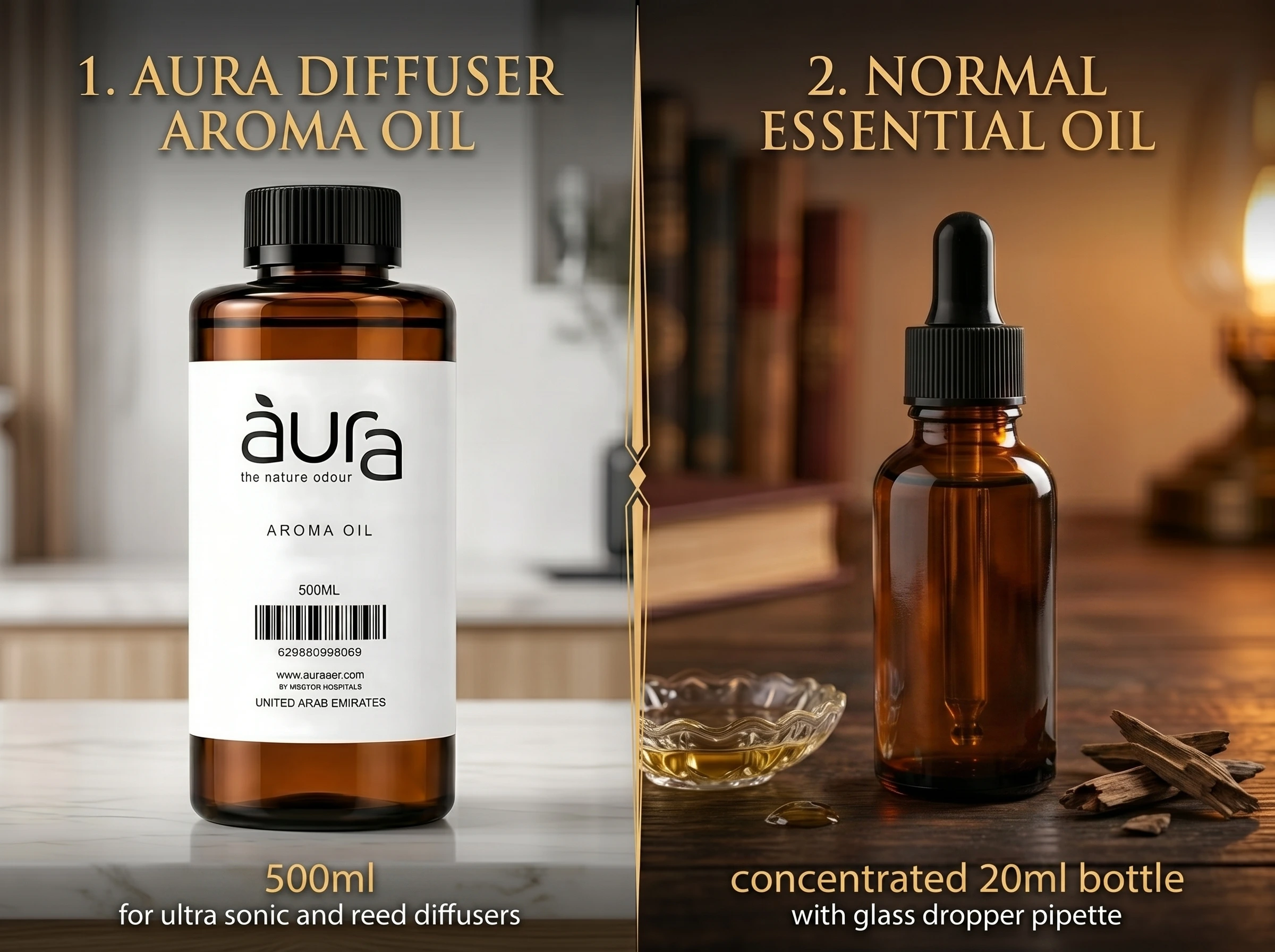
Walk into a pharmacy in Dubai, and you will find a shelf of small dark bottles labeled “essential oil.” Walk into a home store, and you will find a different shelf labeled “diffuser oil.” The prices differ. The bottles look similar. Nobody explains the distinction.
Most people assume they are the same product sold in two places. They are not, and using one where the other belongs is the single most common cause of a diffuser that stops performing properly a few months after purchase.
What an essential oil is
An essential oil is a concentrated aromatic extract taken directly from plant material, usually through steam distillation or cold pressing.
Lavender essential oil is the aromatic compound of lavender flowers, captured and concentrated. Nothing has been added. Nothing has been formulated. It is the plant, reduced.
That purity is what makes essential oils valuable and also what makes them variable. The linalool content of lavender oil shifts depending on growing altitude, harvest timing, and the specific species. Bulgarian highland lavender and Spanish lowland lavandin are both sold as lavender and behave quite differently.
Essential oils are made for a broad range of uses. Topical application, massage, inhalation, cosmetic formulation. Diffusion is one possible use among several, and most bottles are not produced with diffusion specifically in mind.
What a diffuser oil is
A diffuser oil is a formulated product built for one purpose: to be atomized and dispersed into air.
It may contain essential oils. It usually contains several, combined deliberately with other aromatic compounds to produce a specific fragrance profile with a defined structure of opening, heart, and base notes.
The important difference is not the ingredients. It is that the formulation is engineered around the physics of dispersal.
Three things get controlled in a diffuser oil that nobody controls in an essential oil. Viscosity is calibrated so the oil draws cleanly into an atomizer. Volatility across the different compounds is balanced so the fragrance develops evenly rather than the light notes vanishing in the first two minutes. And the profile is designed to work at room scale rather than at the scale of skin or a cupped hand.
An essential oil is an ingredient. A diffuser oil is a finished product designed for a specific machine.
The viscosity problem nobody warns you about
This is where the confusion becomes expensive.
Cold air diffusers work by pulling oil into a pressurised airstream and breaking it into particles measured in microns. That process is engineered for a narrow band of oil thickness.
Some essential oils sit comfortably inside that band. Lavender, eucalyptus, bergamot, peppermint, rosemary all flow freely and atomise cleanly.
Others sit well outside it. Vetiver, benzoin, myrrh, patchouli at full strength and any solvent extracted absolute are thick, heavy, and slow moving. They do not draw properly into the airstream. Particle formation becomes inconsistent, output drops, and over weeks a film accumulates on the mechanism.
Nothing on the bottle tells you which category you are buying. The label says pure essential oil, which is accurate, and says nothing about whether the oil can be atomised.
The carrier oil trap
The most frequent mistake is not about viscosity at all.
Essential oils sold for topical use are almost always pre-diluted in a carrier oil. Sweet almond, jojoba, fractionated coconut. This is done for skin safety, because undiluted essential oils can irritate.
Carrier oils are fatty and they do not atomise. At all. Put a carrier diluted blend into a cold air device and the fatty component coats the internal mechanism with a film that thickens with every session. Output weakens gradually, then significantly, then the device appears to have failed.
The test takes a minute. Put one drop on white tissue and wait sixty seconds. A pure, atomizable oil evaporates and leaves either nothing or a faint ring of color. A carrier-diluted oil leaves a translucent greasy patch that stays.
If it leaves a greasy patch, it belongs on skin, not in a machine.
Why this matters more in a UAE home
Two conditions here make the distinction sharper than it would be elsewhere.
The first is heat. UAE ambient temperatures accelerate oxidation in aromatic compounds. An essential oil stored in a warm room degrades faster than the same bottle in a temperate climate, and degraded oil performs worse in atomisation regardless of what it was originally. Formulated diffuser oils are generally more stable, because stability is one of the properties the formulation controls for.
The second is coverage. UAE rooms are larger in air volume than the rooms most fragrance advice is written for. Higher ceilings, open-plan layouts, and continuous air conditioning moving the air. Getting even coverage across that volume depends on consistent particle size, and consistent particle size depends on the oil being within the range the scent diffuser was built to handle.
A slightly off-specification oil in a small, stuffy European bedroom is barely noticeable. The same oil in a UAE living room is the difference between a scented space and a scented corner.
Which to use when
Essential oils are the right choice for topical use, for massage, for cosmetic formulation, for steam inhalation, and for diffusion in cases where you know the specific oil atomizes well and you have verified it is undiluted.
Diffuser oils are the right choice whenever the goal is a room. They are formulated for the machine, stable in storage, consistent between batches, and designed to produce a fragrance experience at room scale rather than at skin scale.
The mistake is not buying one or the other. It is assuming the label tells you which one you have.
Frequently Asked Questions
What is the difference between diffuser oil and essential oil?
An essential oil is a concentrated extract taken directly from plant material, produced for a range of uses including topical application and cosmetics. A diffuser oil is a formulated product engineered specifically for atomisation, with viscosity calibrated for the machine, volatility balanced across compounds so the fragrance develops evenly, and a profile designed to work at room scale. Essential oils are ingredients. Diffuser oils are finished products built for a specific delivery method.
Can I use essential oil in a cold air diffuser?
Some essential oils work well, provided they are pure and undiluted. Lavender, eucalyptus, bergamot, peppermint, and rosemary all flow freely and atomise cleanly. Thick oils, including vetiver, benzoin, myrrh, and solvent-extracted absolutes are too viscous, producing inconsistent output and residue buildup over time. Any essential oil pre diluted in a carrier such as almond or jojoba should never go into a cold air diffuser, as the fatty component coats the mechanism.
How do I know if an oil is diluted with a carrier oil?
Place one drop on white tissue and wait sixty seconds. A pure atomizable oil evaporates and leaves either nothing or a faint ring of colour. A carrier-diluted oil leaves a translucent greasy patch that remains after the aromatic component has evaporated. That greasy residue is the carrier, and it is what accumulates inside a diffuser mechanism over repeated use.
Why does my diffuser output weaken over time?
The most common cause is residue accumulation on the atomiser from carrier oils or overly viscous oils. Each session leaves a thin film that thickens gradually, restricting the mechanism and reducing particle formation. Output falls slowly at first, then noticeably. Running isopropyl alcohol at 70 percent or higher through the device for five minutes usually restores performance, and switching to oils formulated for atomisation prevents it recurring.
Does UAE heat affect diffuser oil quality?
Yes. Aromatic compounds oxidise faster at higher ambient temperatures, and oxidised oil smells flatter and performs less consistently in atomisation. Store bottles sealed, away from direct sunlight, in the coolest room available rather than near a window or in a warm storage area. Formulated diffuser oils are generally more stable in storage than raw essential oils, because stability is one of the properties the formulation is designed to control.