

From roughly May until late September, a UAE home becomes a closed system.
Windows stay shut. Doors stay shut. The air inside is cooled, filtered, recirculated, and almost entirely disconnected from the world outside. For five months, most residents move between one climate-controlled interior and another with only brief exposures in between.
This is described as a comfort problem and solved as a temperature problem. It is also a sensory problem, and that part goes largely unaddressed.
The body has expectations about environmental variation that a sealed summer interior does not meet. Understanding what those expectations are explains why the same room can feel subtly wearing by August in a way it did not in February, and what aromatherapy is actually doing when introduced into that environment.
What Sensory Constancy Does to the Nervous System
The human nervous system is calibrated for change. It attends to variation and disregards constancy.
Outdoors, environmental input shifts continuously. Temperature drifts. Air moves. Light quality changes through the day. Scent varies with location, season, weather, and time. None of these are consciously tracked, but the nervous system registers all of them and uses them as ongoing signals about time, place, and state.
A sealed interior removes almost every one of these variables. Temperature is fixed within a degree or two. Airflow is constant and directional. Light is largely artificial. And scent, after the first hours in a space, becomes effectively absent because olfactory adaptation eliminates anything constant from conscious perception.
What remains is an environment that is comfortable and almost entirely uninformative.
Research on environmental enrichment across multiple species consistently shows that sensory monotony affects behaviour, stress markers, and mood, while environments with varied and appropriate sensory input do not produce the same effects. The mechanism is not mysterious. Systems designed to process variation behave differently when variation stops.
For UAE residents this is not an abstract finding. It describes the actual condition of most homes for nearly half the year.
The Circadian Problem Inside a Sealed Home
Beyond general monotony, the sealed summer interior interferes with one specific system.
Circadian rhythm is regulated by environmental cues, and light is the strongest of them. But it is not the only one. Temperature variation, activity patterns, and sensory context all contribute to the body’s ongoing sense of what time it is.
In a sealed home with constant temperature, artificial light, and no scent variation between morning and evening, several of those cues weaken simultaneously. The environment at nine in the morning is sensorially identical to the environment at nine at night.
This does not break circadian rhythm outright. Light exposure still dominates, and most people still get enough. But it removes the reinforcing signals that make the transition between daytime alertness and evening wind-down feel natural rather than forced. The result is the familiar UAE summer experience of the evening never quite arriving, of working late without noticing, of the body remaining in daytime mode well past the point where it should have shifted.
Aromatherapy addresses precisely this gap, and it is the clearest case for its use during the sealed months.
The Mechanism That Makes Scent Effective Here
Olfactory signals reach the limbic system through a shorter neural pathway than any other sensory input. Sight, sound, and touch route through the thalamus before reaching the regions that govern emotional state and memory. Smell largely does not.
This matters for two reasons in a sealed environment.
First, it means scent can introduce meaningful variation without introducing disruption. Changing the temperature or the light of an interior has practical consequences. Changing the scent does not. It provides the nervous system with a genuine environmental signal at essentially zero cost to the comfort of the space.
Second, it means the signal is processed quickly and below conscious awareness, which is exactly the level at which circadian and state cues operate. You do not consciously reason your way into the evening. The body arrives there in response to cues. Scent is one of the few cues that can be deliberately controlled indoors without altering anything else.
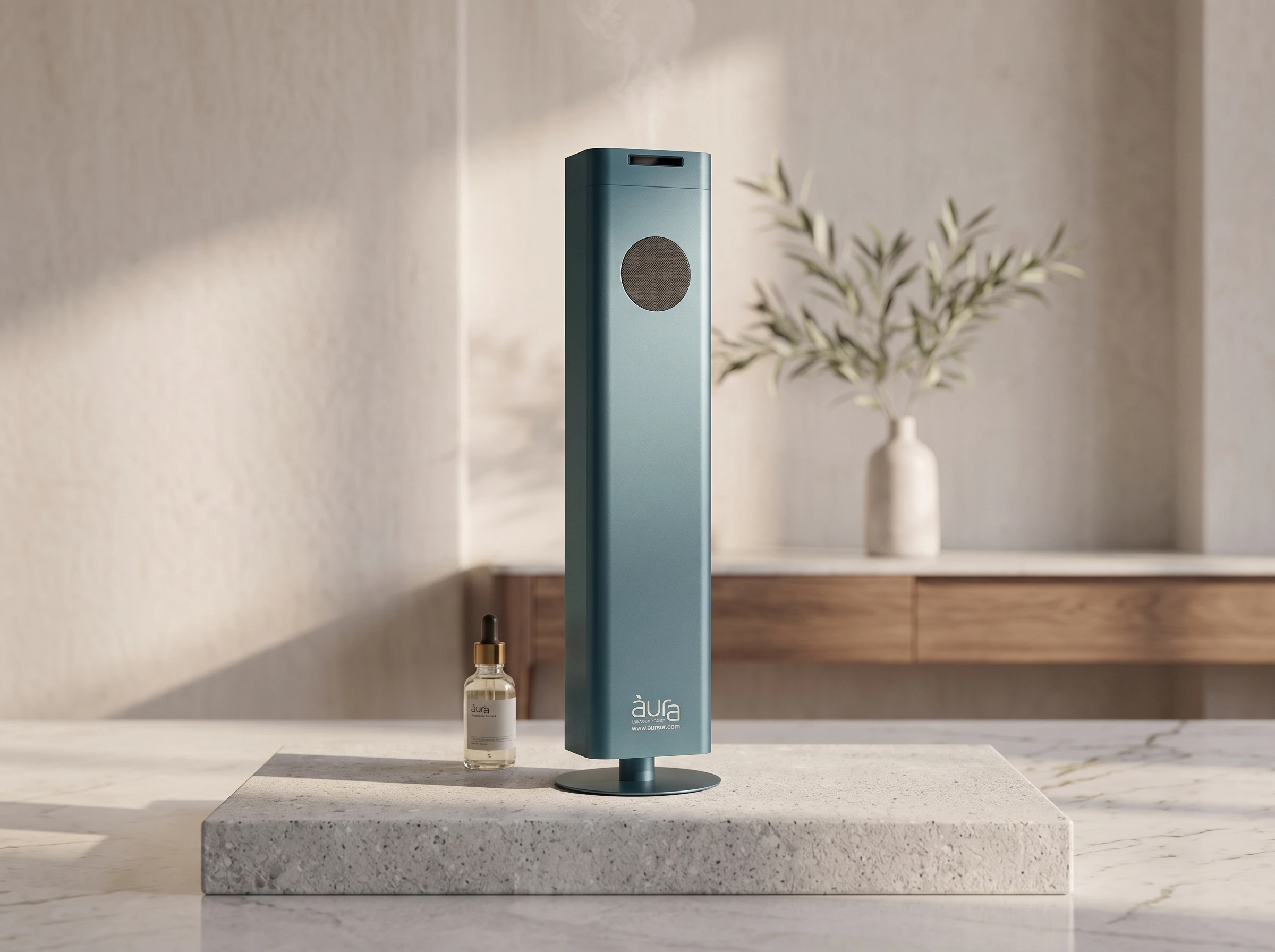
An aromatherapy diffuser running a different profile in the morning than in the evening restores a variation the sealed interior removed. That variation is not decorative. It is doing the work that changing outdoor conditions would otherwise do.
What This Looks Like Physiologically
Two mechanisms are operating and they work on different timescales.
The immediate one is compound based. Linalool, present in lavender, interacts with GABA-A receptors and produces measurable reductions in physiological arousal, including cortisol changes documented in controlled settings. This effect occurs within minutes and does not depend on habit or expectation.
The slower one is associative. When a specific scent is consistently present at a specific point in the daily cycle, the nervous system begins treating it as a predictive signal. Over roughly two weeks of consistency, the scent itself starts producing aspects of the associated state before the compound effect has had time to act.
In a sealed environment the second mechanism carries more weight than it does outdoors, because it faces less competition. Where an open home receives changing light, air, and outdoor scent as competing cues, a sealed home receives almost none. A deliberately introduced scent signal is close to the only environmental variable present, which makes the association form more cleanly and hold more strongly.
This is the aspect of aromatherapy that is most underestimated in UAE conditions. The sealed interior that creates the problem also makes the intervention unusually effective.
What Changes and What Does Not
Being precise about this matters, because overstated claims make the real effects harder to believe.
An aromatherapy diffuser does not improve indoor air quality in any technical sense. It does not filter, purify, or remove particulates. Those are separate functions performed by separate equipment.
It does not compensate for insufficient daylight exposure. If circadian rhythm is disrupted primarily by lack of morning light, a scent will not resolve that. Light exposure will.
What it does is reintroduce a controllable environmental variable into a space that has lost nearly all of them and use that variable to mark the transitions the sealed environment no longer marks on its own. Morning feels different from evening. The end of the working day registers as an actual change rather than a continuation. The nervous system receives a signal it can use.
Across five months of sealed living, that is not a small thing. It is the difference between a home that is merely comfortable and one that is actively participating in how you feel inside it.
Frequently Asked Questions
Does aromatherapy work differently in a sealed air conditioned home?
Yes, and generally more effectively. A sealed interior removes most environmental variation, which means an introduced scent faces very little competing sensory input. Associative conditioning, where the nervous system learns to treat a scent as a signal for a particular state, forms more cleanly under those conditions. The compound level effects remain the same, but the learned response tends to establish faster and hold more strongly than in a naturally ventilated home.
Why do UAE homes feel sensorially flat during summer?
Because almost every environmental variable is held constant. Temperature is fixed, airflow is steady and directional, light is largely artificial, and any constant scent disappears from perception through olfactory adaptation within the first hour. The nervous system is calibrated to attend to variation, so an environment with almost no variation provides very little input, even while remaining entirely comfortable.
Can an aromatherapy diffuser help with the feeling that evening never arrives?
Partly. Circadian rhythm relies on environmental cues, and a sealed interior weakens several of them at once by keeping temperature, light, and scent constant across the whole day. Using distinctly different scent profiles in the morning and evening restores one of those cues. It does not replace light exposure, which remains the dominant circadian signal, but it reintroduces a transition marker the sealed environment removed.
How long does it take for aromatherapy to have an effect in a sealed home?
Compound level effects such as the interaction between linalool and GABA-A receptors begin within minutes and occur on every exposure. The associative effect, where the scent alone triggers a state, requires roughly two weeks of consistent daily use at the same point in the cycle. In sealed environments this second effect often establishes faster than in naturally ventilated homes because there are fewer competing environmental cues.
Does an aromatherapy diffuser improve air quality in a sealed home?
No. It does not filter air, remove particulates, or alter humidity. Those functions require separate equipment. What it does is introduce a controlled sensory variable into an environment where nearly all natural variation has been removed, and use that variable to mark daily transitions the sealed environment no longer marks on its own.