

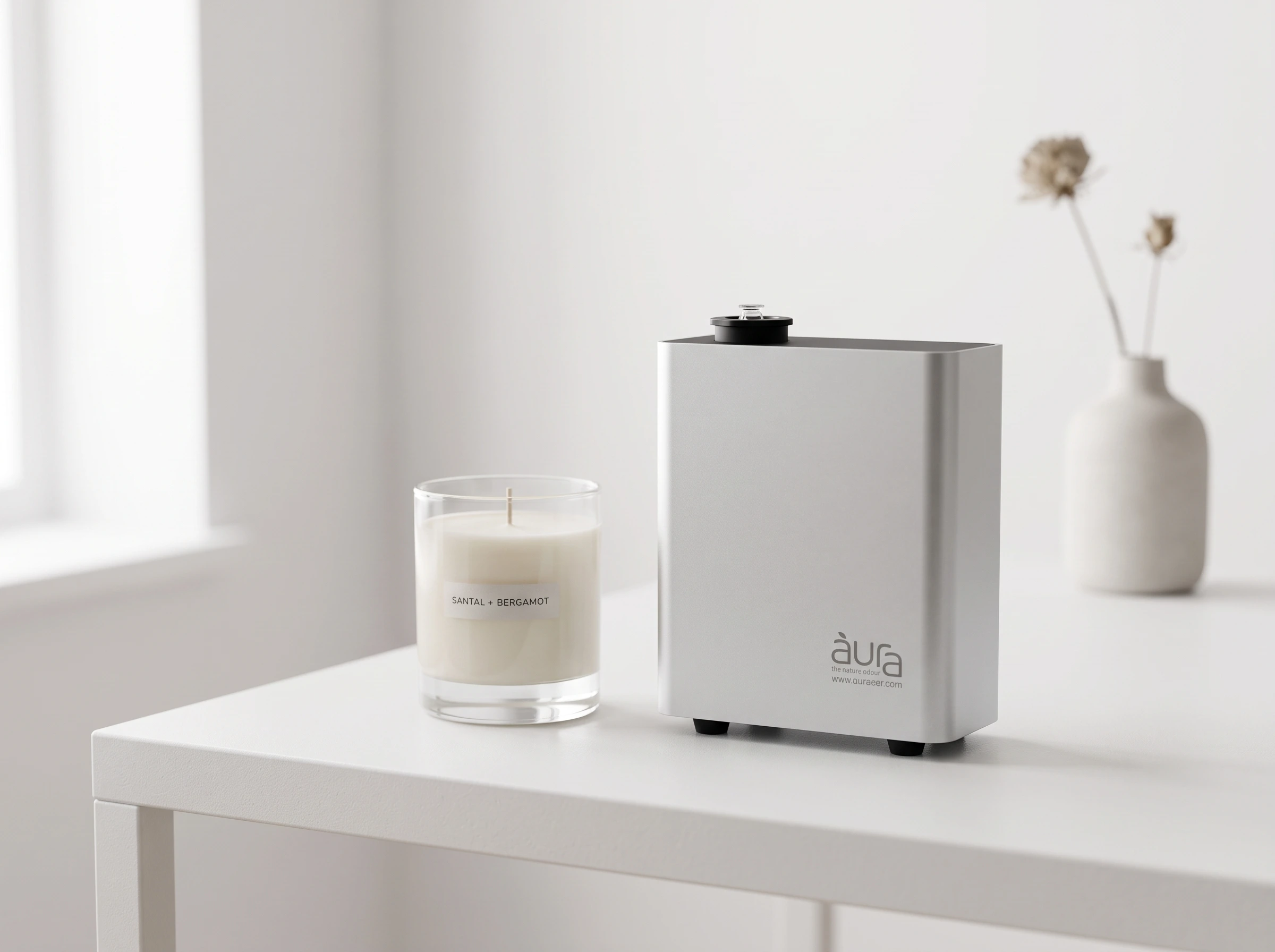
Scented candles are not going anywhere.
They look good on a shelf. They photograph well. They are available in every home fragrance store across Dubai and Abu Dhabi. And for many UAE residents, they are the first and only home fragrance tool they have used consistently.
The comparison between candles and cold-air aromatherapy diffusers is worth making honestly rather than dismissively. Candles do some things genuinely well. They also have real limitations that most candle brands do not discuss because they would rather you keep buying candles.
Here is the full picture.
What Candles Actually Do Well
Starting here matters because a comparison that dismisses the competition entirely is not credible and not useful.
Aesthetic presence. A well-made candle in a quality vessel is a genuinely beautiful object. The flame creates movement and warmth in a room that a diffuser does not. For UAE residents whose home aesthetic is built around considered interior design, a candle contributes to the visual environment in a way that a cold-air diffuser, however well-designed, does not replicate. This is a real advantage, and it is not trivial.
Immediate scent impact. A candle produces a strong scent throw in the area immediately around it within a few minutes of lighting. For a small, low-ceilinged space without air conditioning running—a powder room, a study with no AC vent, a closed balcony room a candle can fill the space adequately with minimal equipment.
Ritual and mood. Lighting a candle is a deliberate act that marks a transition. For many people it signals the beginning of an evening, a bath, or a specific kind of relaxation. The ritual dimension of candle use is psychologically real and is not fully replaceable by starting a diffuser on an app timer. This matters.
Where Candles Fall Short in UAE Homes Specifically
Several of the limitations that apply to candles globally apply with greater force in UAE residential environments.
Heat changes the fragrance chemistry. This is not a marketing claim. It is chemistry. The aromatic compounds in fragrance oils have specific molecular structures that produce their documented effects, including the linalool in lavender that interacts with GABA receptors and the limonene in citrus that produces alertness. Combustion applies thermal energy to these compounds. Some evaporate intact. Some oxidize. Some combust partially. What reaches your nose from a burning candle is not the same compound profile as the oil that was poured into the wax.
For a candle used purely as ambient scent without any wellness intention, this may not matter. For a candle marketed as aromatherapy—promoting sleep, reducing stress, and improving focus—the thermal degradation of the active compounds means the product cannot deliver what the marketing claims. The smell is present. The mechanism is not.
Fire risk in UAE interiors. UAE apartments typically have fitted carpets, curtains, and soft furnishings in close proximity to each other. The fire risk from unattended candles in UAE residential settings is not hypothetical. Insurance data from UAE property insurers consistently lists candle fires among the leading causes of residential property damage. Families with children and pets in particular are managing a real risk with every candle left burning in an occupied room.
UAE fire regulations. Several residential building management companies and community associations across Dubai and Abu Dhabi either restrict or explicitly prohibit open-flame candles in apartments and townhouses within their properties. This is not widely advertised, but it is enforceable, and some UAE residents have found this out after an incident. A cold-air diffuser has no open flame and presents no regulatory concern in any UAE residential classification.
Soot and indoor air quality. Candle combustion produces particulate matter. The black residue visible above candle flames and on surfaces near candles over time is carbon from incomplete combustion. Indoor air quality research consistently shows elevated particulate levels in rooms where candles have been burning for an extended period. In the sealed, recirculated indoor air environment of a UAE home, those particles stay in circulation longer than they would in a naturally ventilated space. For residents with respiratory sensitivities or with young children, this is a meaningful consideration.
Coverage area. Even the highest-quality three-wick candle produces effective scent coverage of approximately 25 to 40 square meters under ideal conditions—a still, low-ceilinged room with no air conditioning running. A UAE living room with AC at full intensity, four-meter ceilings, and an open-plan connection to a dining area is not those conditions. The AC airflow disrupts the heat-convection mechanism that drives candle scent throw, pulling fragrance toward the return vents before it distributes through the room. Most UAE residents are getting significantly less than the marketed coverage from their candles.
What a Cold-Air Aromatherapy Diffuser Does Differently
Compound integrity. The linalool in a lavender oil dispersed through cold-air atomization arrives at your olfactory receptors chemically identical to what was in the bottle. The documented mechanisms—GABA receptor interaction, parasympathetic activation, and cortisol reduction—apply because the compounds responsible for them are intact. This is the fundamental difference between aromatherapy that functions as wellness and aromatherapy that functions only as ambient scent.
Coverage in UAE conditions. Cold-air nanoparticles integrate with HVAC airflow rather than being disrupted by it. In a large open-plan UAE living area with AC running continuously, the ventilation system becomes the distribution network for cold-air-diffused fragrance rather than its opponent. A correctly sized aromatherapy diffusers covers the actual air volume of the space rather than the theoretical marketing coverage figure.
Consistency and automation. A candle requires lighting, supervision, and extinguishing. It cannot be started remotely. It cannot be set to run for a specific period and switch off automatically. It cannot be adjusted from another room when the intensity is not right. Cold-air diffusers with Bluetooth and Wi-Fi app control handle all of these limitations. The fragrance environment is scheduled, automated, and adjustable without physical intervention. For the pre-sleep routine, the morning work session, or the arrival experience before guests come, remote scheduling delivers the fragrance at exactly the right moment without requiring you to be home first.
No fire risk, no soot, no regulatory concern. This is not a complex point, but it is a real one for UAE residential contexts specifically. Cold-air diffusion produces no combustion, no particulate, no carbon byproduct, and no open flame. It presents no fire risk, no air quality concern, and no regulatory issue in any UAE residential building classification.
The Cases Where Each Is the Right Choice
Choose candles when:
The goal is visual and aesthetic. You want the flame, the vessel, the warmth of the object as part of the room’s visual design. You are in a small, contained space without AC running. You are marking a specific ritual occasion where the physical act of lighting something carries meaning.
Choose a cold-air aromatherapy diffuser when:
The goal is genuine fragrance coverage across a full UAE room or connected open-plan space. You want the documented wellness mechanisms stress relief, sleep improvement, focus to actually function rather than just smell like they should. You want the fragrance environment automated and consistent without supervision. You have children, pets, or anyone with respiratory sensitivities in the home. You live in a UAE apartment building with fire regulation restrictions on open flames.
The Honest Verdict
These are not competing products in the same category.
A candle is an object with a fragrance component. An aromatherapy diffuser is a fragrance delivery system with an aesthetic component. They serve different primary purposes and are best understood as complementary rather than substitutes.
UAE residents who use both intentionally candles for their visual and ritual contribution and cold-air diffusers for genuine whole-room fragrance coverage and wellness function get more from their home fragrance environment than those who rely on either alone.
The mistake is treating one as a direct replacement for the other. The candle cannot do what the diffuser does at scale in a UAE home. The diffuser cannot replicate what a candle does aesthetically. Understanding the actual capability of each prevents the disappointment of expecting one to perform the job of the other.
Frequently Asked Questions
Is an aromatherapy diffuser better than scented candles for UAE homes?
For whole-room fragrance coverage in UAE conditions, cold-air diffusers significantly outperform candles. UAE homes with AC running continuously and open-plan layouts reduce candle scent throw substantially because airflow disrupts the heat-convection mechanism candles rely on. Cold-air diffusers integrate with HVAC airflow and cover the actual room volume. For visual aesthetic and ritual purposes, candles still offer something diffusers do not. They serve different primary functions rather than being direct substitutes.
Do scented candles damage indoor air quality in UAE homes?
Candle combustion produces particulate matter, including soot and carbon compounds from incomplete combustion. In the sealed, recirculated indoor air environment of UAE homes where AC prevents natural ventilation, these particles circulate longer than they would in naturally ventilated spaces. Research on indoor air quality consistently shows elevated particulate levels in rooms with candles burning for extended periods. Cold-air diffusion produces no combustion, no soot, and no particulate byproduct.
Can you use candles in UAE apartments?
Some residential communities and building management companies across Dubai and Abu Dhabi restrict or prohibit open-flame candles in apartments, particularly in high-rise buildings. These restrictions are not consistently advertised but are enforceable. Cold-air diffusers have no open flame and present no regulatory concern in any UAE residential building classification.
Why do scented candles not work well for aromatherapy?
Combustion thermally degrades the aromatic compounds responsible for documented aromatherapy effects. Linalool in lavender, limonene in citrus, and incensole acetate in frankincense are specific molecules that interact with neurological receptors to produce their wellness effects. Heat from combustion oxidises and partially destroys these compounds before they reach the olfactory receptors. A candle that smells of lavender does not deliver linalool at therapeutic concentrations. A cold-air diffuser preserves compounds intact at ambient temperature.
How does candle scent throw compare to a cold-air diffuser in a large UAE room?
A high-quality candle covers approximately 25 to 40 square meters under ideal conditions, including still air and no AC running. A UAE open-plan living area with active AC and four-meter ceilings is not those conditions. AC airflow pulls candle fragrance toward return vents before it distributes through the room, reducing effective coverage significantly. A correctly sized cold-air diffuser covers its rated cubic meter volume in UAE AC conditions because cold-air particles integrate with HVAC airflow rather than being disrupted by it.
Should you use candles and diffusers together in a UAE home?
Yes, as complementary tools serving different purposes rather than substitutes. Candles contribute visual warmth and ritual meaning that diffusers do not replicate. Cold-air diffusers provide whole-room fragrance coverage, compound integrity, automation, and wellness functions that candles do not replicate. UAE residents who use both intentionally get more from their home fragrance environment than those who rely on either alone.