

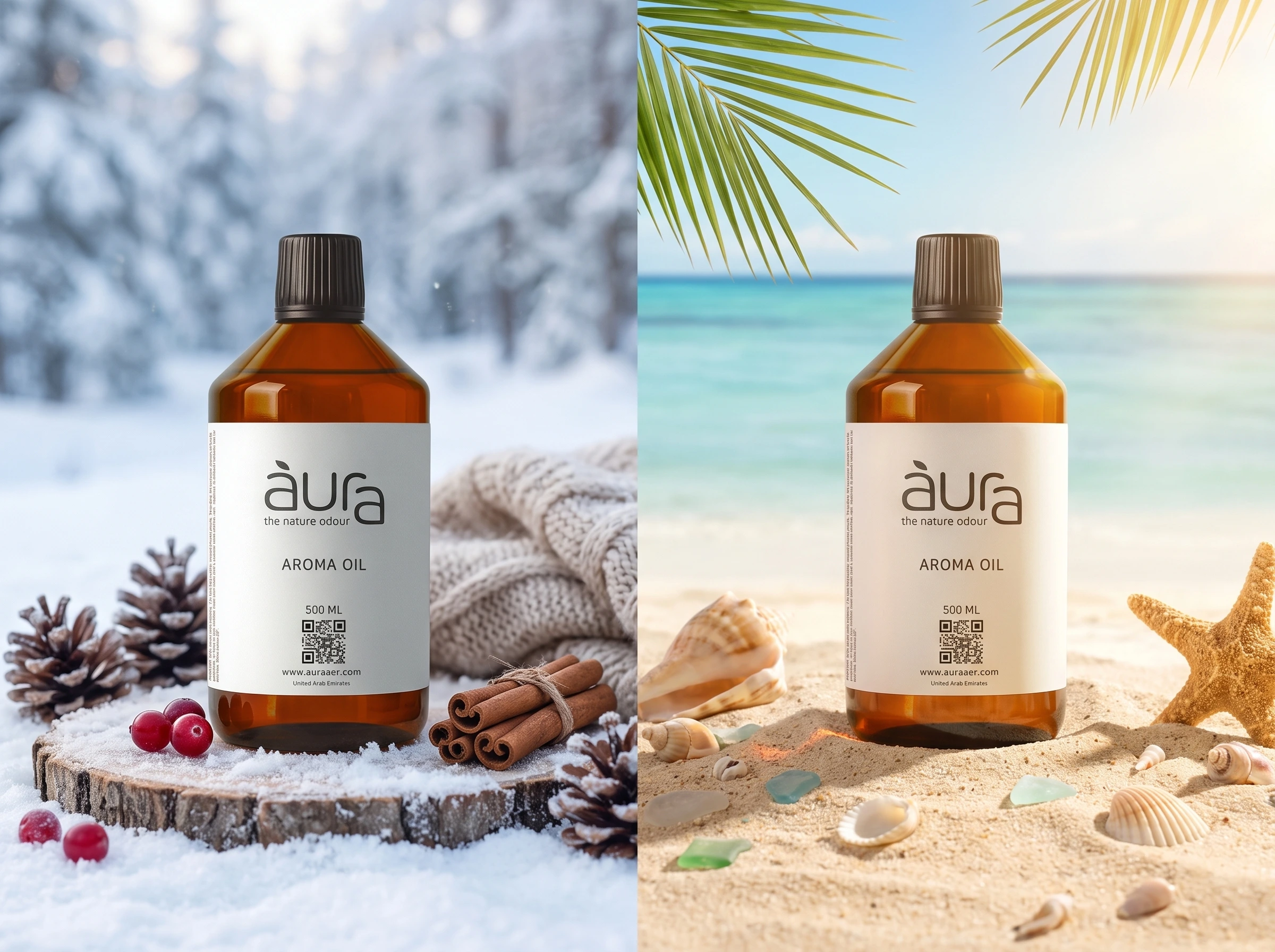
Seasonal fragrance advice is written almost entirely for temperate climates.
Change to warmer, lighter scents in spring. Bring in the heavy spice and wood profiles in autumn. These recommendations assume four seasons, variable outdoor temperatures, and homes that open and close their windows as the weather changes.
UAE homes do not work this way.
The indoor climate of a Dubai apartment or villa is managed by air conditioning year-round. The sensory relationship between indoors and outdoors that drives seasonal fragrance changes in most climates is largely absent here. Which leads most UAE residents to run the same fragrance profile through June as they do through January, treating home scenting as a fixed rather than an adjustable element of the indoor environment.
This is a missed opportunity. Because while the UAE does not have four seasons in the conventional sense, it has two indoor climate states that are meaningfully different, and those differences affect how fragrance performs, how it feels, and what profiles are appropriate for each period.
The Two Indoor Seasons of a UAE Home
The sealed season May through September
During peak summer, UAE homes are sealed environments. Windows stay closed. AC runs at maximum capacity. Indoor air exchange rates are high because the cooling load requires continuous circulation. The indoor environment is consistently cool, consistently dry, and completely disconnected from the outdoor world.
The sensory experience of being indoors during UAE summer is one of controlled, hermetic comfort. The air is neutral and managed. There is no breeze, no outdoor fragrance, no variation in the sensory input from one day to the next. The indoor environment provides relief from the heat but offers very little sensory richness beyond the temperature itself.
Fragrance in this context does specific work. It introduces the only variable sensory element in an otherwise uniform indoor environment. The profile matters because there is nothing competing with it. In a room that smells of nothing except managed air, even a moderately scented diffuser has significant presence. Overweighting the profile and the sealed environment amplify it to oppression. Underweight it, and the AC strips the fragrance before it has time to establish any ambient presence.
The open season October through April
From October onward, UAE evenings become genuinely pleasant. The windows are open for the first time in months. Outdoor air enters homes, carrying the variable sensory character of the cooler Gulf climate, occasional humidity from the sea, the dust-adjacent quality of the desert air after sunset, and the specific night jasmine scent that appears in UAE residential areas during winter evenings.
The indoor-outdoor boundary becomes permeable in a way it is not for half the year. Natural scent enters the home from outside. The indoor fragrance environment is no longer sealed and controlled but mixed with whatever comes through the window.
Fragrance in this context needs to hold its own against the variable character of the outdoor air entering the space. It also needs to complement rather than compete with the natural sensory richness that the cooler months bring to UAE interiors.
Sealed Season Profiles what Works from May to September
The primary requirement for sealed-season UAE fragrance is restraint.
The sealed indoor environment amplifies fragrance concentration in a way open or variably ventilated spaces do not. An intensity setting that produces pleasant ambient scenting in October feels noticeably stronger in July in the same room at the same settings. This is because the high AC air exchange rate, while it moves particles quickly, also contains them within the sealed indoor volume more completely than air that has any outdoor outlet.
The right profiles for UAE summer interiors are clean, light, and explicitly not heavy.
Aquatic and green accords perform particularly well in the sealed season. They introduce a quality of freshness that the managed AC air lacks without adding the warmth or density that sealed environments amplify problematically. A green tea and marine accord running at 20 to 25 percent intensity in a sealed UAE summer living room produces a sensation of coolness and freshness that reinforces rather than conflicts with the AC environment.
Light citrus remains appropriate for daytime hours. The top-note-heavy character of citrus profiles actually suits the sealed season because the high air exchange rates that clear top notes quickly in winter circulate them more broadly through the full indoor volume in summer, making the coverage more even.
White musk is the most versatile sealed-season base note. It provides depth and persistence without the warmth or density of oud, sandalwood, or amber profiles that are better suited to the cooler months.
The profiles to avoid during summer in sealed UAE interiors:
Heavy oriental blends at full concentration. The sealed environment takes an oud-amber-spice combination from luxurious to overwhelming within a single diffuser cycle. If you want to run these profiles year-round, reduce intensity by 30 to 40 percent during the sealed season compared to your winter settings.
Dense floral absolutes including full-concentration rose and jasmine. These profiles need air movement and outdoor context to read correctly. In a sealed, managed environment, they read as heavy and commercial rather than natural and luxurious.
Open Season Profiles What Works from October to April
The cooler months give UAE fragrance the context it needs to do its best work.
When windows are open and outdoor air is entering the space, the indoor fragrance environment is competing with and complementing natural sensory input from outside. The profiles that thrive in this context are the ones with enough presence and depth to hold their character against variable outdoor air.
This is the season for the Gulf fragrance tradition to come fully into its own indoors.
Oud and oriental blends are correctly calibrated for UAE winter interiors. The cool, slightly humid evening air that enters from open windows provides the natural ventilation that oud profiles need to develop properly. Oud in a sealed summer interior becomes concentrated and dense. Oud in a winter evening interior with airflow moving through the space develops in layers, the warmth of the resinous base expanding into the cooler air, the top notes refreshing with each new cycle.
AuraAer’s diffuser aroma oil collection includes Gulf-inspired oud and oriental blends formulated specifically for cold-air diffusion in UAE interior conditions. These profiles are most effective during the open season when the natural ventilation allows the full fragrance architecture to develop correctly.
Frankincense and amber perform with particular richness during the UAE’s cooler months. The association between these profiles and winter evenings, family gatherings, ceremonies, and the cultural rituals that UAE residents observe more intensively during the cooler season adds a conditioned layer to the pharmacological warmth these oils produce. Running frankincense during Ramadan and the National Day period is not seasonal decoration. It is activating one of the most powerful fragrance-memory associations in the Gulf cultural calendar.
Rose and sandalwood blends suit the transition months of October, November, March, and April when the evenings are cool but the days are still warm. Rose has the complexity to hold up against variable outdoor air without becoming oppressive in a not-yet-fully-sealed interior. Sandalwood provides the base persistence that ensures the blend remains present through the night even as the cooler air circulates.
The Transition How to Shift Between Seasons
The shift between sealed and open season should not be abrupt. A household that runs heavy oud through winter and switches immediately to light aquatic profiles when the AC goes back to full summer intensity in May will experience a sensory discontinuity that feels jarring rather than intentional.
A more considered transition, over two to three weeks in April and May and again in October and November, moves gradually from the heavier open-season profiles toward the lighter sealed-season ones and back. During the transition weeks, run the summer profile in the daytime when windows are closed and the winter profile in the evening when there is still some outdoor air movement. This bridges the seasonal change without a hard cutover.
The diffuser aromatherapy oils in AuraAer’s luxury range are formulated for cold-air diffusion performance across both UAE indoor seasons. The oud and oriental collection suits the open season. The cleaner floral and green accord profiles suit the so-called season. The full range covers the full UAE indoor climate year without requiring oils sourced from multiple suppliers or formulated for non-UAE conditions.
A Practical Seasonal Scenting Calendar for UAE Homes
May through September — Sealed season
Morning: citrus or eucalyptus at 20 percent
Evening: white musk or green tea accord at 20 to 25 percent
Bedroom: lavender at 20 percent on 90-minute timer
Avoid: heavy oud at standard settings, dense florals, amber-heavy profiles
October through April — Open season
Morning: bergamot or rosemary at 25 to 30 percent
Evening: oud blend or frankincense-amber at 30 to 35 percent
Bedroom: frankincense-lavender blend at 20 to 25 percent on 90-minute timer
Ramadan and National Day: frankincense at 30 percent as primary signature
Transition weeks (April through May, October through November)
Daytime: lighter profile at 20 percent
Evening: richer profile at 25 percent, reducing intensity rather than changing oils
Frequently Asked Questions
Should you use different fragrance oils in UAE homes in summer versus winter?
Yes. UAE summer creates a sealed, high-AC-exchange indoor environment that amplifies fragrance concentration and suits lighter, cleaner profiles, including aquatic, citrus, and white musk. UAE winter allows windows to open, creating a variable indoor-outdoor environment where heavier profiles, including oud, frankincense, and amber, develop correctly. Running the same heavy oriental profile year-round produces an oppressive result in summer-sealed interiors that the same profile avoids in winter open ones.
What fragrance profiles work best in UAE homes during summer?
Clean, light, and low-density profiles suit UAE sealed-season interiors. Aquatic and green tea accords introduce freshness without the warmth that amplifies problematically in sealed environments. Light citrus works well for daytime hours. White musk provides base persistence without density. Heavy oud, dense florals, and amber-heavy blends should either be avoided or run at 30 to 40 percent lower intensity than their winter settings.
What are the best aroma oils for UAE homes in winter?
The cooler UAE months from October through April suit oud and oriental blends, frankincense and amber profiles, and rose-sandalwood combinations. The natural ventilation from open windows allows these profiles to develop in layers rather than becoming concentrated in a sealed environment. Gulf cultural associations between oud and frankincense and the winter social season in the UAE make these profiles particularly resonant during Ramadan and the National Day period.
How do you transition between seasonal fragrance profiles in a UAE home?
Over two to three weeks during April through May and again October through November, run the lighter summer profile during daytime hours when windows are closed and the richer winter profile during evenings when outdoor air is still moving through the space. This bridges the seasonal shift without a hard cutover that feels sensorially discontinuous. Reduce intensity gradually rather than switching profiles abruptly.
Does air conditioning affect how fragrance oils perform in UAE homes?
Significantly. High AC air exchange rates during UAE summer move fragrance particles quickly through the indoor volume, dispersing top notes faster than in lower-exchange environments. This makes top-note-heavy profiles feel stronger but shorter during peak summer. Base-note-heavy profiles persist longer in the circulated air but can become concentrated in the sealed volume. Adjusting intensity downward by 20 to 30 percent during summer compared to winter settings compensates for the concentration effect of the sealed environment.