

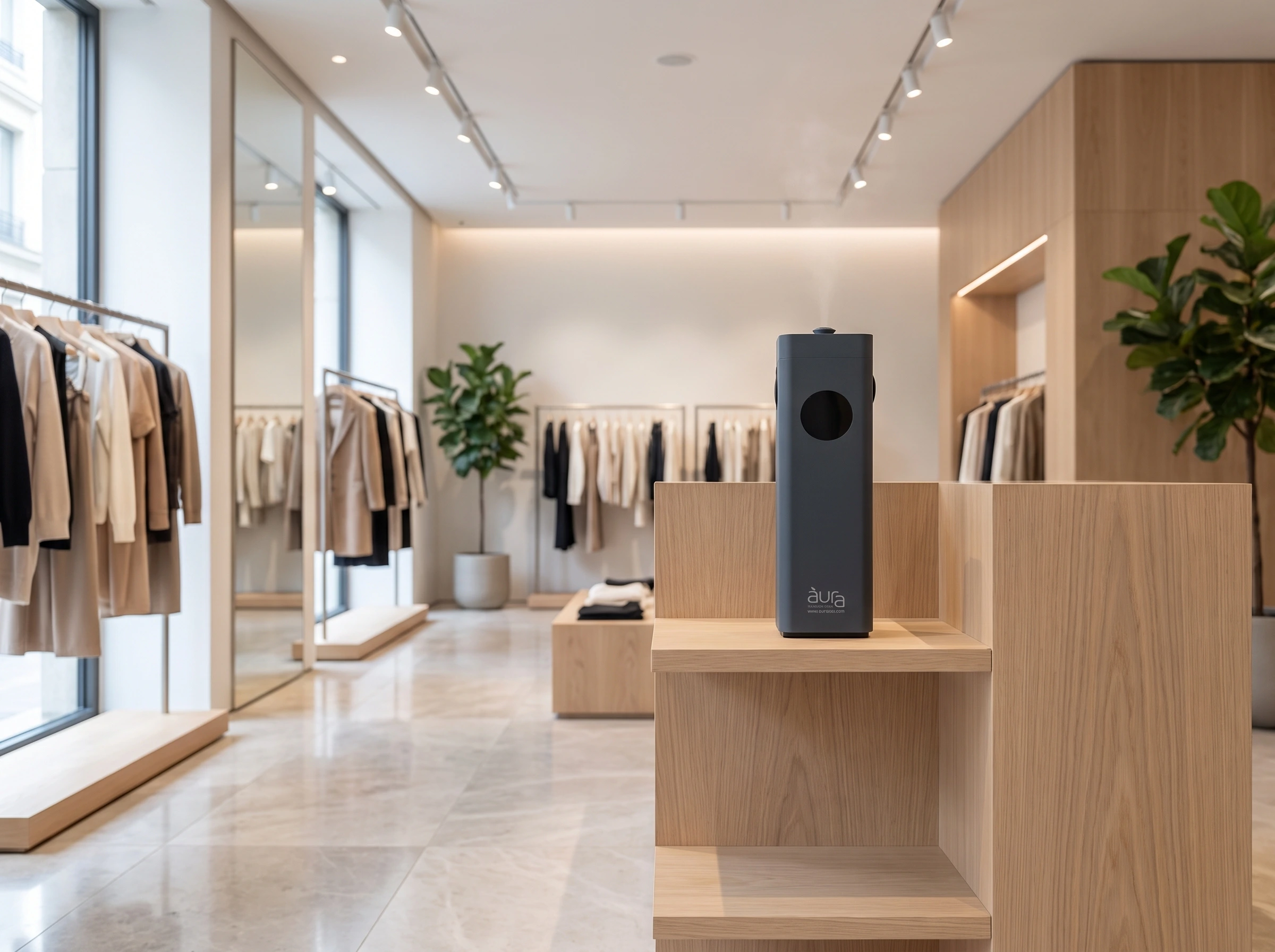
There is a retail store in Dubai Mall that has been using the same signature scent since it opened.
Most regular visitors to that store cannot name the fragrance. Most of them could not describe it if asked. But virtually all of them would notice immediately if it changed or disappeared. They would describe the store as feeling different, less welcoming, and somehow off, without being able to articulate why.
This is ambient scenting working exactly as intended. Not noticed consciously. Felt immediately. Affecting behaviour without announcing itself.
The retail industry has known about the commercial value of ambient scenting for longer than most other sectors. The research base is substantial, the mechanisms are well understood, and the implementation technology has reached a point where a mid-sized UAE retail store can achieve the same quality of ambient scenting that luxury flagships have used for decades.
What has not caught up with the research is the average UAE independent retailer’s awareness that this option exists and what it actually requires.
What the Research Actually Shows About Retail Scenting
The foundational retail scenting research comes from consumer psychologist Eric Spangenberg and colleagues at Washington State University, who conducted a series of studies throughout the 1990s and 2000s examining the effect of ambient scent on retail behavior.
Their findings were consistent across multiple study designs. Scented retail environments produced longer customer dwell time, higher purchase intent scores, and more positive store evaluations than identical unscented environments. Critically, customers in scented environments did not attribute their improved experience to the scent when asked. They described the store as better organised, more pleasant, and having higher quality products, none of which had changed. The scent was doing its work on perception and behaviour without registering as the cause.
A 2012 study in the Journal of Retailing and Consumer Services extended this research specifically to the congruence effect — the finding that scents which match the merchandise category produce stronger positive outcomes than pleasant but mismatched scents. A bakery that smells of fresh bread outperforms one that smells of flowers, even if customers prefer flowers in other contexts. A sportswear store that uses a clean, energising fragrance outperforms one that uses a heavy oriental blend, regardless of the absolute pleasantness of either scent.
This congruence principle is important for UAE retailers because it means the goal is not simply having a pleasant-smelling store. It is having a store that smells consistently with what it sells and who it sells to.
Why UAE Retail Spaces Have a Specific Opportunity
The UAE retail environment has characteristics that make ambient scenting both more impactful and more technically achievable than in most other markets.
Malls dominate the retail landscape in a way that is unique to the Gulf. When a customer walks from the common area of a Dubai mall into a retail store, they are moving from a shared, neutrally scented space into a brand-owned environment. That transition point is the moment when the first impression of the store is formed. A store that has a distinctive ambient scent creates an immediate sensory boundary between the mall corridor and the brand environment. That boundary is a powerful brand differentiation tool that no visual or audio element produces as immediately.
The sealed, air-conditioned indoor environment of UAE retail spaces also makes cold-air scent diffusion particularly effective technically. Cold-air nano-particles stay suspended in managed indoor air longer than in variable-temperature or naturally ventilated environments. A correctly sized diffuser in a UAE retail space maintains consistent ambient fragrance across the full footprint of the store throughout trading hours without the oil consumption and performance variability that open or naturally ventilated spaces produce.
Finally, the UAE customer base is arguably the most fragrance-aware consumer market in the world. Personal fragrance spend per capita in the UAE is among the highest globally. The customer entering a UAE retail store has a more developed olfactory awareness than the average customer in most other retail markets. A store that uses scent well is noticed positively by this customer in a way that produces stronger brand associations than the same approach in a less fragrance-conscious market.
Which Scent Works for Which Retail Category
The congruence principle applies directly to UAE retail category selection.
Luxury fashion and jewellery
Deep, warm, resinous profiles. Light oud character, white musks, sandalwood, ambergris-adjacent notes. The fragrance should communicate exclusivity and permanence rather than freshness and accessibility. Heavy enough to create presence but not so dense that it competes with the merchandise or the customer’s personal fragrance. Run at 20 to 25 percent intensity in the mid-range. The customer spending significant time considering a high-value purchase should feel the environment is appropriately calibrated for that decision rather than feeling rushed by an energising or stimulating fragrance profile.
Sportswear, fitness and outdoor retail
Clean, energising profiles. Eucalyptus, green tea, citrus accords, light mint. The fragrance should reinforce physical vitality and freshness rather than luxury or relaxation. Higher intensity is appropriate here because the merchandise and the customer mindset both support a more assertive sensory environment. A gym supplement store that smells of eucalyptus and clean air is communicating product efficacy before a single label is read.
Home furnishings and interior design stores
This is where UAE retailers have the most specific opportunity and the most common mistake. A furniture or home furnishings store should smell like a home, not like a store. Warm, liveable, domestic profiles, linen, light cedar, subtle vanilla, soft florals. The fragrance should support the customer’s ability to imagine the product in their own living space. A home store that smells aggressively branded interrupts that imagination rather than supporting it.
Health, wellness and pharmacy retail
Clinical cleanliness is not the right brief for a wellness retail environment. Pure clinical smells register as hospitals rather than health. Light eucalyptus, green tea, chamomile, and lavender profiles communicate wellness and care rather than illness and treatment. The distinction matters commercially because customers spending on wellness products respond to an environment that feels aspirationally healthy rather than medically necessary.
F&B and cafe retail
The most powerful retail scent signal is the actual product smell for food and beverage retail. Coffee aroma in a cafe. Bread in a bakery. Chocolate in a confectionery store. Where the product smell is present naturally, the role of a diffuser is to extend and stabilise it rather than to replace it with an artificial equivalent. A coffee shop that uses a coffee-adjacent fragrance oil in a cold-air diffuser in the entrance area creates a fragrance signal that reaches customers before they reach the point-of-sale serving the actual product. The scent converts footfall into intention before a word is exchanged.
How to Implement Retail Scenting in a UAE Store Correctly
Size the device to the actual air volume of the sales floor
This is where most retail scenting implementations fail in their first month. A device rated for 200 cubic meters placed in a 500 cubic meter open-plan retail store covers a zone around the unit rather than the full sales floor. Measure the floor area of your retail space and multiply by the ceiling height to get cubic meters. Select a cold-air diffuser with a coverage rating at or above that volume.
For UAE retail spaces with high-traffic entries where customers are constantly bringing in warm outdoor air, size up rather than selecting the minimum coverage rating. The additional air exchange from door openings during trading hours requires more output than the static room volume calculation predicts.
Position for entrance impact first
The highest-value placement in any retail store is within three to five metres of the customer entrance. This is where the first impression forms and where the olfactory signal most reliably transitions the customer from mall corridor to brand environment. Position the primary device near the entrance at 80 centimeters to 1.2 meters height, away from direct air conditioning supply vents.
For larger stores, a second unit positioned toward the rear or at a secondary department draws customers deeper into the space. Research on retail footfall patterns consistently finds that scent gradients, where the fragrance is slightly stronger in certain areas than others, direct customer movement toward those areas without signage or obvious cues.
Run on a consistent schedule throughout trading hours
A scent diffuser that runs inconsistently through the trading day undermines the conditioning response you are trying to build with regular customers. A customer who associates your store with a specific ambient scent because it was present on their last three visits will notice its absence on the fourth visit before they have registered anything else. Consistency is what converts a pleasant smell into a brand association.
Set the device schedule to start fifteen to twenty minutes before the store opens and run on a cycle schedule throughout trading hours. The app control on AuraAer commercial units allows this to be set once and run automatically without manual intervention each day.
Maintain the fragrance consistency between visits
If you change fragrance profiles frequently, the conditioning benefit is lost. A retail store that smells of citrus one week and oriental the next has pleasant air but no signature scent. Choose a fragrance brief that serves your merchandise category and your brand identity and maintain it consistently. The commercial value of ambient scenting accumulates with consistency and largely disappears with inconsistency.
The ROI Conversation for UAE Retail
For UAE retail operators evaluating the commercial case, the numbers are not complex.
A correctly sized cold-air aroma diffuser for a mid-sized UAE retail space requires a capital investment comparable to a few days of retail staff cost. Monthly oil consumption at appropriate intensity for a standard retail trading schedule represents a fraction of the daily marketing spend most UAE retailers maintain across social media and paid advertising channels.
The documented performance effects from retail scenting research — increased dwell time, higher purchase intent, more positive brand evaluation, stronger return visit likelihood — apply across retail formats. The investment is small relative to the output it affects. The primary cost is not the device or the oil. It is the attention required to select the right fragrance brief, size the device correctly, and run the system consistently.
Done correctly, the return on a retail scenting implementation is felt within the first month and compounds with every visit from every returning customer who is building the association between your store and its ambient fragrance.
Frequently Asked Questions
Do scent diffusers actually increase sales in retail stores?
Research from Washington State University found that scented retail environments consistently produce longer customer dwell time, higher purchase intent, and more positive store evaluations than identical unscented environments. Customers in scented environments attributed their improved experience to store quality and organisation rather than to the scent itself. The commercial effect is real and documented across multiple independent study designs. The congruence effect means the scent must match the merchandise category to produce maximum commercial benefit.
What scent should a retail store use in UAE?
The correct brief depends on the merchandise category. Luxury fashion and jewellery suits warm resinous profiles including light oud and sandalwood. Sportswear and fitness retail suits clean energising profiles including eucalyptus and citrus. Home furnishings stores benefit from domestic, liveable profiles including linen and soft cedar. Wellness and pharmacy retail suits light eucalyptus and chamomile. The guiding principle is congruence between the fragrance and what the store sells rather than selecting the most personally pleasant option.
What size scent diffuser does a retail store in UAE need?
Calculate the cubic metre volume of the retail sales floor by multiplying floor area by ceiling height. Select a cold-air diffuser with a coverage rating at or above that volume. For UAE retail stores with active customer entry points bringing warm outdoor air in during trading hours, size up from the minimum coverage rating to account for additional air exchange. A device rated for 200 cubic metres is appropriate for a small boutique. A mid-sized store of 300 to 600 square metres requires a commercial grade unit rated for 1000 cubic metres or higher.
Where should a scent diffuser be positioned in a retail store?
The primary unit should be positioned within three to five metres of the customer entrance at 80 centimetres to 1.2 metres height, away from direct AC supply vents. This placement creates the fragrance signal at the transition point between the mall corridor and the brand environment, where the first impression forms. For larger stores, a secondary unit toward the rear or at a key department draws customers deeper into the space through a subtle fragrance gradient that directs footfall without signage.
How often should you change the fragrance in a retail store?
The commercial value of retail scenting comes from consistent repetition that builds a conditioned association between the fragrance and the store in returning customers. Changing fragrance profiles frequently eliminates this benefit. Choose a fragrance brief aligned with your merchandise category and brand identity and maintain it as a signature rather than varying it seasonally or by trend. The fragrance should be as stable as your logo rather than as variable as your window display.
Is retail scenting relevant for smaller UAE independent stores or only luxury retailers?
The documented commercial benefits of retail scenting apply across retail formats and scales. The investment required for a correctly implemented ambient scenting system in a small- to mid-sized UAE independent store is proportionally small relative to other marketing expenditures. The customer base in the UAE is particularly fragrance-aware compared to most global retail markets, meaning the signal-to-noise ratio of good ambient scenting is higher here than in markets where customers are less attuned to fragrance as an environmental quality indicator.